The Barber of the Alpena by J. Harwood

ONE summer evening, two or three years ago, a group of passengers were sitting on the after-deck of the steamer City of Alpena, of the Detroit and Mackinac line, upward bound.

Most of them were strangers to each other, but, as fellow-passengers, they had been brought into social contact for the time, and the conversation was general.

There had been some talk on the subject of acquaintances formed in this way; and of men who, living in places far apart, and following widely different avocations, were brought together by the controlling force of circumstances, and for a few days traveled the same path.

Thence the conversation had drifted to employments and pursuits in general, and the causes which determined their choice; the consensus of opinion being that what seemed chance was really more potent than any deliberate process of choice.

“You can prove that by me, gentlemen,” said a man who was sitting with his chair tilted back against the rail.

I had frequently noticed this man about the boat during the trip. He was a glib, voluble fellow, and was selling a patent chair of his own invention, which he called the “Mechanico-Artistic Wonder.” It was a curious, complicated affair, suited to the uses of barbers, dentists, surgeons, and invalids; it was adjusted by means of a system of joints, levers, arms, cogs, and what not, and was specially adapted to the purpose of permitting the occupant to assume, or be placed in, any possible position or posture of which the human body is susceptible; and, if desired, as in the case of an insane patient, of holding him fast when so placed.

But what attracted special attention to the man was not his invention, but his face. Ordinarily, and when in repose, there was nothing out of the common about it; but the moment that he became keenly interested or excited, his features underwent a startling change.

At such times, his nose, which was a pronounced aquiline, seemed actually to push itself forward from his face, drawing the skin so tightly that the bridge seemed breaking through it, showing a narrow white strip down the middle; while the upper lip was drawn up at the angles of the mouth, exposing about a quarter of an inch of the sharp, white points of his canine teeth. This odd protrusion of the bridge of his nose also tightened and drew forward the skin under his eyes,—which were set very close together,—bringing down the outer corners, and giving those organs the appearance of two moons in the quarter.

All the characteristics of his bizarre features were in full play as he told his story.

“I used to be a barber. It was my chosen profession from my childhood. I think it was reading about the barber in the ‘Arabian Nights’, when I was a kid, that fixed my choice. Anyway, I always thought, and still think, that there is no business in the world so desirable all round as that.

“I learned my trade—or art, as I call it—in the city of New York, and worked in a big shop there for ten years, saving most of my wages. About five years ago I came West and started a bang-up shop for myself in a small city, the name of which I won’t mention. I am a top-notch artist, and kept good assistants, and for three years everything went well, and I made money. I had considerable education when a boy, and a taste for reading, which I always kept up. My place was first class, and first-class men patronized me, and I had personal friends and intimates among the best and most intelligent people. There was a medical college in the city, and among my friends were some of the students and faculty. One day, by invitation, I accompanied a party of the students to one of their lectures, or clinics, or whatever they call them. It was in a great barn of a room at the top of the building, with no windows but skylights. They had a dead man there, lying on his back on a table in the middle of the room, and were dissecting his face. The professor did most of the work and talking. He would cut away at it awhile, and then explain the thing to the students. Occasionally one of the boys would take a hand at the carving, under the direction of the professor. All this time the dead man’s eyes were wide open, staring at them, as piece by piece they peeled the skin and flesh from his bones! It was a horrible sight to me, and made me sick at the stomach besides, but they didn’t appear to mind it a bit, but went on cutting away at that dead face, as cool and deliberate as I would go about shaving a man, all the while talking, laughing, and joking each other, as unconcerned as you please.

“I tell you it made me sick clear through; and after the longest two hours I ever spent, I was glad to have the lecture over with, and get out into God’s free air again. I must have looked white around the gills, for the boys joked me unmercifully; told me to come again, and come often, and I would like it after a while. The professor, with a wink to the boys, said he thought I was intended by nature for a surgeon, and advised me to exchange the razor for the scalpel. He also offered to show me the ‘pickling vat.’ I declined the invitation and went home; but the affair had so upset my stomach and nerves that I was hardly fit for work for several days.

“And then began a queer state of things. Every time a customer got into my chair, with head thrown back and face upturned, it reminded me of that dead man’s face, and as I stood over it with my razor, the thought would come, ‘What if I was a surgeon and was going to dissect this countenance?’ And then I would find myself thinking, ‘Suppose I do?’ and an impulse to do it in reality began to take hold of me, faint at first, but growing stronger every day. And this infernal idea stuck, and I could not drive it away. We hear of people who, standing by a well or a precipice, sometimes feel a strange impulse to jump down. At last I got a good deal in the same way. The inclination to cut and carve the faces of my customers became so strong that I felt I was fast losing control of myself. It would make the hearts of a good many prominent citizens of that town stop beating now, could they know how narrowly they sometimes escaped having their throats cut when under my hands.

“I have had the strength all go out of me, and leave me with beads of sweat standing on my forehead, and my hands all of a tremble, from the struggle I made to resist the cursed temptation. I realized what the end of it was sure to be some day, and might be any day, so I quit business for a time, took a trip for my health, and got medicine from the doctors for nervous derangement. I didn’t tell them what shape my nervous fits took, though.

“Away from the shop I got better, and after a few weeks thought I was over it, and went back to work. But it was no use, the first face that looked up at me from the chair was to me that dead man’s face. It happened that this first customer was the professor who advised me to exchange my razor for a scalpel. I forced myself through the job in some way, so awkwardly, though, that he spoke of his former advice, and remarked that if I couldn’t handle the scalpel any better than I was then using my razor, I had better give up both and take to a shoe brush. If he had known how mighty near I came to using my razor as a scalpel on that occasion, he would sooner have been in the bottom of his pickling vat than in my chair.

“That was the last time I attempted to practise my art. I quit the business, went to work on some ideas that had been forming in my mind for several years, and invented the Mechanico-Artistic Wonder, my incomparable chair, and have since been introducing it to an appreciative public. I am all right now, am in good health and spirits, and don’t think I have any murderous impulses lurking in my system; but it is not likely I shall ever return to my old trade. I like it better than anything else, and at times I feel a strong inclination to try it again; but the risk is too great. The chair business is fairly good, and growing better, and it suits me well enough, though it is not in it with the tonsorial line.”

As he finished his story, the ex-barber arose from his seat, yawned, stretched himself, and looked around upon the company. The excitement of his narrative had brought into full play all the peculiarities of his eccentric features. His moon eyes were like crescents in his forehead, the bridge of his nose was thrust away forward, the white streak down the middle of it gleamed like a narrow band of silver, and the points of his sharp teeth looked like pendants of ivory hanging from the corners of his mouth.

As it was growing late, the company soon separated, and, one after another, sought their berths. I know not how it was with others, but the barber’s story, with the horrible possibilities suggested by it, haunted me all night.

At daylight the next morning, we touched at Cheboygan, where my partner and I, with our guns, fishing tackle, and camping outfit, went ashore, leaving the big steamer with most of her passengers, including the ex-barber, to proceed on her trip.

A month passed, a month of life in the woods; and with brown, bearded faces, shaggy hair, and wolfish appetites, we were again in Cheboygan, on our way homeward.

Of course the first thing we looked out for was a shave, and we entered the first shop we came to. There was but one operator, and my partner proposed that I take the first turn, while he went down to the dock and looked after some of our stuff; it would take but a few minutes, he said, and he would be back by the time I was finished.

The shop was on the main street, and the chair in which I seated myself was near the window. In the excitement and enjoyment of the past few weeks, the impression which had been produced upon my mind by the story of the barber on the steamer had lost its vividness, and now I seldom thought of it.

I know the gruesome subject was not in my mind as I took my seat, laid back my head, and suffered myself to be enveloped to the chin in the customary white apron.

But as the operator bent over me, tucking in the edges of the cloth around my neck, it came to me quick and sharp as a flash of lightning. Just then he gave the back of the chair a tilt, stepped in front of me, and took a general survey of his preparations.

Oh, horrible! Is it?—no, impossible! My God, yes! It is the barber of the Alpena!

As his eyes met mine, they lit up with a devilish gleam, the big nose began to bulge forward, throwing into sharp relief the sinister white streak; the tightening skin drew down and inward the corners of his eyes, and his lip jerked upward, revealing the points of his wolfish tusks.

With a cry of terror, a cry that had no manhood in it, a cry that was the howl of a tortured beast, I put forth my strength and tried to spring to my feet. Vain effort! Head, hand, and foot, I was held fast in the complicated machinery of the Mechanico-Artistic Wonder!

With every muscle strained to the utmost tension, I struggled, as a man might struggle in the lethal coil of a python,—and to as little purpose. It was as if I had been caught in the hardening rock of the earth’s foundation, and there lay fast locked, immovable forever.

When, finally, utterly exhausted, I ceased my struggles, the fearful being, who, with arms folded, had been standing perfectly still, regarding me with a half smile of mingled curiosity and amusement, nodded his head approvingly, and turned to a small table covered with the tools and apparatus of his trade.

And then followed a scene of inconceivable horror.

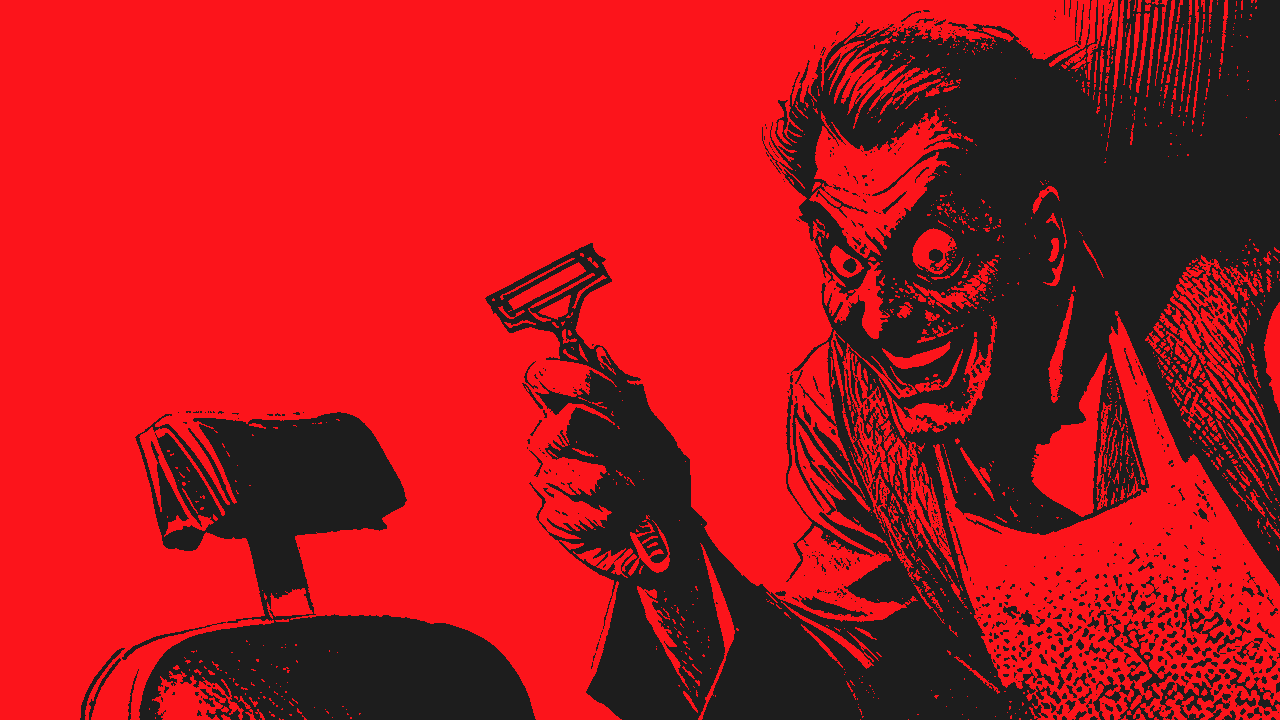
Carefully selecting a razor from among several lying on the table, he gave it a few rapid strokes across his strap, and then closely examined its edge with eye and finger. Apparently satisfied with its condition, he slapped it briskly on the palm of his hand, approaching me as he did so.

In the agony of that awful moment, I again struggled to free myself, and sent forth cries that seemed to me should alarm every inhabitant of the town, and reach the ears of the people on the boats far out in the lake. To all this, the human hyena, in whose power I was, gave no heed whatever. He seemed neither to hear my cries nor see my struggles. He appeared absorbed in his dreadful purpose, and, coming close beside me, deliberately and gently took the tip of my nose between the thumb and finger of one hand, and with the other carefully applied the edge of the razor to my face just underneath the eye, and then slowly drew it down my cheek, and around to the point of my chin. The keen edge stung like a streak of fire, and I felt the blood trickling down my face. Another long cut on the other side, and then another,—and still another! My blood was now flowing in streams; I could feel it soaking into the cloth around my neck, and hear it dropping on the floor; and as the butcher stepped back, and deliberately contemplated the progress of his work, I saw that his hands and arms were covered with it.

A moment’s scrutiny, and he was back again. Now he began cutting away and lifting the edges of the skin from the long gashes he had made. The infernal demon was flaying me, literally skinning me alive!

During all this time I was not passive. With superhuman strength, born of pain and terror, I struggled incessantly, filling the air with shrieks and cries.

The shop was on the ground floor, and, as before stated, the chair in which I was now suffering the torments of a horrible death was close to a window opening upon a busy street, along which scores of people were all the time passing in full view, few of whom went by without looking in and seeing my condition. All this I saw by rolling my eyes to one side, my head, as well as every other part of my body, being immovable. Yet, inconceivable as it must seem, not a soul came to my assistance.

Most of those who looked in at the window smiled as they passed on. Some would pause an instant and coolly contemplate the bloody tragedy, but always with an expression of amusement on their faces, and a smile as they turned away. At times groups of children would form outside the window, and with juvenile gesticulations and laughter, evince their enjoyment of the spectacle. One big boy stood for a long time with his nose flattened against the glass, and a broad grin on his face.

How long all this was going on, I could not tell. In my agony it seemed hours. And all the time the monster was deliberately and silently working away at his fearful task. I could no longer cry for help, and silently prayed for death. Would the demon never have done with his work? Should I never die?

But now the door of the shop opened, and—blessed sight—my partner entered! At once my flickering hope revived. I looked for the swift blow that should lay the monster on the floor; the wrench of the strong arm that should tear the infernal chair in pieces and set me free.

But, oh, impossible, incredible! O dastardly, treacherous monstrous! My partner stood a moment coolly looking at me, then broke into a hearty laugh, and, taking a seat, began blowing great clouds of tobacco smoke in my direction. In a moment I saw his lips move, and he spoke to me. I seemed not to hear what he said, but summoned all my forces for one last desperate effort to free myself. Thank heaven! At last the fastenings which held me gave way. I staggered to my feet and stood erect.

At this, the barber stepped quickly back to his table and seized something,—a bludgeon, or sand-bag, or maul, I knew not what,—and began beating me about the head and shoulders. As his pelting blows fell like electric shocks, I blindly reached out my hands to grapple with him, and tried to shout something. The next instant, a cloud seemed to fall around me, filling the room and hiding everything. I could see nothing; but from the darkness came the words, clear and distinct:—

“Twenty-five cents, sir, please.”

Instantly the cloud lifted, and the barber, with whisk broom in one hand, and the other extended for his fee, was standing before me in an attitude of respectful expectancy.

Mechanically—and almost unconsciously,—I produced the coin and gave it to him. With a feeling of bewilderment, I passed both hands over my face; no blood nor trace, on face or hand, of the dreadful ordeal through which I had passed! Mentally unsettled, and still more than half unconscious, I walked across the room and sat down.

“What’s the matter, John?” said my partner. “You act as though you had just waked up. You looked so queer when I came in that I thought the razor must be dull. I’ll give it a try now, but I warn our friend here, that if his jaw-scythe pulls too hard, I shall do something besides make faces at him.”

While speaking, he took his place in the chair I had just vacated.

I looked at the chair attentively, and at the barber. He was not the barber of the Alpena, and bore no resemblance to him whatever; and the chair was the ordinary affair seen in barbers’ shops, and not in the least like the Mechanico-Artistic Wonder! Wondering and dazed, I replied, with as steady a tone and manner as I could assume, that I felt a little dull and sleepy, and would take a stroll and a smoke while he was being shaved. I walked around for half an hour, and composed my unsettled faculties as well as I could before rejoining my companion; but all through the day, I was hardly in my normal mental condition. I said nothing of my frightful experience to my partner then; but the next day, when on board the steamer, bound down the river, I sounded him for any possible experience of his own in that barber’s chair. Upon learning that nothing strange had happened to him or come into his mind while in the shop, I finally told him the whole story. He is a kind of occultist, or theosophist, or something of that sort, and was soon ready with a full, and complete explanation.

“You were mesmerized,” said he, “involuntarily mesmerized, by that barber. And as it was involuntary on his part, he was not conscious of the matter at all, knew nothing about it, and so made no suggestions affecting or influencing your mental condition or action while you were in that state. Your screams were imaginary. The people who passed laughed at you on account of your queer grimaces. The ‘bludgeon’ was a whisk broom. Your vision, which was a kind of hypnotic nightmare, was a subjective phantasma on the plane of your own sub-consciousness, which was saturated, so to speak, with the diablerie of the infernal story that ghastly, moon-eyed, bony-nosed vampire told on the boat.

“That is the whole rationale of the matter; it is all simple enough.”

“But,” he added, after a moment’s thought, “I don’t believe I shall ever feel perfectly safe in a barber’s chair again.”

As for me, I have ever since let my beard grow: and my wife cuts my hair.


From: The Black Cat, Vol. I, No. 12, September 1896

The Dead Woman by David H Keller

He was found in the room with his wife, slightly confused, a trifle bewildered, but otherwise apparently normal. He made no effort to conceal his conduct any more than he did to the knife in his hand or the pieces in the trunk.

Fortunately the inspector was an officer of more than usual intelligence, and there was no effort made to give the third degree or even secure a written confession. Perhaps the Police Department felt it was too plain a case. At least it was handled intelligently and in a most scientific manner. The man was well fed, carefully bedded, and the next morning, after being bathed and shaved was taken to see a psychiatrist.

The specialist in mental diseases had the man comfortably seated. Knowing he smoked, he offered a cigar, which was accepted. Then, in a quiet, pleasant atmosphere, he made one statement and one request.

“I am sure, Mr. Thompson, that you had an excellent reason for acting as you did the other day. I wish you would tell me all about it.”

The man gazed at the psychiatrist. “Will you believe me if I tell you?”

“I will accept every part of your story with the idea that you are convinced that you are telling me the truth.”

“That is all I want,” whispered Thompson. “If everyone I talked to in the past had done that, if they had even tried to check up on my story, perhaps this would not have happened. But they always thought that I was the sick one, and there was not one who was willing to accept my statement about the worms.

“I suppose that I was happily married. At least as much so as most men are. You know that there is a good deal of conflict between the sexes, and there were a few differences of opinion between Mrs. Thompson and myself. But not enough to cause serious difficulty. Will you remember that? That we did not quarrel very much?

“About a year ago my wife’s health began to give me considerable cause for worry. She started to fail. If you are a married man, Doctor, you know there is always that anxiety about the wife’s health. You become accustomed to living with a woman, having her do things for you, go to places with you and you think about how life would be if she should sicken and die. Perhaps the fact that you are uneasy about the future makes you exaggerate the importance of her symptoms.

“At any rate she became sick, developed a nasty cough and lost weight. I spoke to her about it and even bought a bottle of beef, wine and iron at the drug store and made her take it. She did so to please me, but she never would admit that she was sick. Said it was fashionable to be thin and that the cough was just nervousness.

“She would not go to see a doctor. When I spoke to her mother about it, the old lady just laughed at me; said that if I tried to make Lizzie a little happier she would soon get fat. In fact, none of our family or our friends seemed to feel that there was anything wrong with Mrs. Thompson, so I stopped talking about it.

“Of course it was not easy on me, the way she coughed at night, and her staying awake so much. I work hard in the daytime and it is hard to lose a lot of sleep. At last I was forced to ask her to let me sleep in the spare bedroom.

“Even that did not help much. I could hear her cough, and when she did fall asleep I would have to tiptoe into her room and see if she was all right. Her coughing bothered me so much that when she did not cough it worried me more because I thought something had happened to her.

“One night the thing I was afraid of happened. She had a hard spell of coughing and then she stopped. It was quiet in the house. I could hear the clock on the landing tick, and a mouse gnawing wood in the attic. I thought I could even hear my own heart beat, but there was not a sound of any kind from the other bedroom.

“When I went in there and turned on the light I just knew it was all over. Of course I was not sure. A bookkeeper is not supposed to be an expert in such matters, so I went and telephoned for our doctor. On the way to the phone I wondered just what I should say, for he had always insisted that my wife was in grand health. So I simply told him that Mrs. Thompson was not looking well and would he come over. Just like that I told him, and tried to keep my voice steady.

“It was about an hour before he came. He went into the bedroom but I stopped at the doorway. He spent sometime listening to her heart and feeling her pulse and then he straightened up and said to me:

“‘She is fine. Just fast asleep. I wish I could sleep as soundly as that. What did you think was wrong?’

“That surprised me so much that all I could do was to stammer something about not hearing her cough any more. He laughed.

“‘You worry too much about her, Mr. Thompson.’

“Right there my difficulty started. Here was a doctor who was supposed to know his business and he said there was nothing wrong with my wife, and there I was, just a bookkeeper, and I just knew what was the matter. What was I to do? Tell him that he was wrong? Send for another physician?

“It was growing light by that time, so I went down to the kitchen and started the coffee. I often did that. Then I shaved, and made ready to go to the office. But before I went I sat down a while by the wife’s bed. It bothered me but I had to keep telling myself that the doctor knew better than I did.

“Before leaving the house I phoned to my mother-in-law. Just told her that Lizzie was not feeling well and would she come over and spend the day, and she could get me at the office any time she called. Then I left the house. It felt better out in the sunshine and after working a few hours over the books I almost laughed at myself for being so foolish.

“No telephone calls from the old lady. I arrived home at six and found the house lighted as usual. My wife and mother-in-law were waiting for me in the parlor and told me supper was ready. Naturally, I was surprised to see my wife out of bed.

“At the supper table I watched her just as carefully as I could without making the two of them suspicious of me. Mrs. Thompson ate about as she usually did, just pieced and minced at her food, but I thought when she swallowed that the food went down with a jerk, and there was a stiffness when she moved.

“But her mother did not seem to think there was anything wrong, at least she did not make any comment. Even when I went with her to the front door to say good night to her and we were alone there, she never said a word to show that she thought her daughter was peculiar.

“I started to wash the dishes after that. I often washed the dishes at night while the wife sat in the front parlor watching the people go up and down past the house. After the kitchen was tidy I lit a cigar and went into the parlor and started a little conversation, but Mrs. Thompson never talked back. In fact I do not believe she ever talked to me after that, though I am positive that she talked to the others.

“When the cigar was smoked, I just said good night and went to bed. Later I could hear her moving around in her room, and then all was quiet so she must have gone to bed. She did not cough any more. I congratulated myself on that one thing because the coughing had kept me awake a good deal.

“During the night I lit a candle and, shading it with my hand, tiptoed in to see her. She had her eyes open, but they were rolled back so all you could see was the whites, and she was not breathing. At least I could not tell that she was breathing; and when I held a mirror in front of her mouth there was no vapor on it. My mother had told me the purpose of that when I was a boy.

“The next day was just the same. My mother-in-law came and spent the day. I came home at night and ate supper with them and washed the dishes. The water was hot and it was a pleasure to make them clean. Perhaps I took longer than usual at it because I did not fancy the idea of going into the front parlor where the wife was sitting looking out of the window.

“But I went in, tonight without the usual cigar. I wanted to use my nose. It seemed there was a peculiar odor in the house, like flowers that had been put in a vase of water and then forgotten, for many days. Perhaps you know the odor, Doctor, a heavy one, like lilies of the valley in a small closed room. It was specially strong in the parlor, where Mrs. Thompson was sitting, and it seemed to come from her. I had to light the cigar after a while, and by and by I said good night, and went to bed. She never spoke to me, in fact she did not seem to pay any attention to me.

“About two that morning I took the candle and went in to look at her. Her eyelids were open and her eyeballs were rolled back just like they had been the night before but now her jaw was dropped and her cheeks sunk in. I just could not do anything but telephone for a doctor and this time I picked out a total stranger, just picked his name out of the telephone book haphazard.

“What good did it do? None at all. He came, he examined Mrs. Thompson very carefully and he simply said that he did not see anything wrong with her; and then down in the front hall he turned on me and asked me just why I had sent for him and what I thought was the matter with her? Of course I just could not tell him the truth, with his being a doctor and I being just a bookkeeper.

“My mother-in-law went to the mountains next day for the summer and that left us alone. Breakfast as usual and to the office and not a word all day from the house. When I came back at night the house was lit and supper was on the table and the wife at her end as usual and the food served and on the plates. She ate, but her movements were slower, and when she swallowed you could see the food go down by jerks, and her eyes were sunken into the sockets and seemed shiny and— well, like the eyes of a fish on the stalls.

“There were flowers on the table, but the smell was something different, it was sweeter and when I took a deep breath it was just hard for me to go on eating the pork chops and potatoes. You see it was summer time and warm, and in spite of the screens there was a fly or two in the house, and when I saw one walking around on her lip and she not making any effort to brush it off, I just couldn’t keep on eating. Had to go and start washing the dishes. Perhaps you can understand how I felt, Doctor. Things looked rather odd.

“The next day I phoned to the office that I would not be there and I sent for a taxi and took Mrs. Thompson to a first class specialist. He must have been good because he charged me twenty-five dollars just for the office call. I went in first and told him just exactly what I was afraid of, and I did not mince my words, and then we had the wife in.

“He examined her, even her blood, and all the satisfaction I got was that she seemed a trifle anemic, but that I had better take a nerve tonic and a vacation or I would be sick.

“Things looked rather twisted after that. Either I was right and everybody else wrong, or they were right and I was just about as wrong mentally as a man could be. But I had to believe my senses. A man just has to believe what he sees and hears and feels, and when I thought over that office visit, and the wife smiling and the doctor sticking her finger for the blood to examine, it just seemed impossible. Anemic! Why—that was a simple word to describe her condition.

“That night the flies were worse than usual. I went to the corner store and bought a fly spray and used it in her bedroom but they kept coming in, the big blue ones, you know. Seemed as though they just had to come in and I could not keep them off her face so at last, in desperation, I covered her head up with a towel and went to sleep. I had to work, the interest on the mortgage was due and the man wanted something on the principal, and it was a good house and all I had in the world to show for twenty years of hard work keeping books.

“The next day was just like all the days had been, except that I made more mistakes with the books and my boss spoke to me about it. And when I arrived home supper was not ready though Mrs. Thompson was in the parlor and the lights on. The heavy odor was worse than usual and there were a lot of flies. You could hear them buzz and strike against the electric lights. I got my own supper but I couldn’t eat much, thinking of her in the parlor and the flies settling on her open mouth.

“She just sat there that night in the parlor till I went to her and took her arm to lead her up the stairs. She was cold and on each cheek there was a heavy purple blotch forming. Once she was in her room she seemed to move around so I left her alone and when I went into her room later on she was in bed.

“It had been a hard week for me, so I sat down by her bed and tried to think, but the more I thought the worse things seemed. The night was hot and the flies kept buzzing; just thinking of the past and how we used to go to the movies together and laugh and sometimes come near crying, and how we used to bluff about the fact that perhaps it was just as well we didn’t have a child so long as we had each other, knowing all the time that she was eating her heart out for longing to be a mother and blaming me for her loneliness.

“The thinking was too much for me so I thought I might as well smoke another cigar and go to bed and try to keep better books the next day and hold my job — and then I saw the little worm crawl out.

“Right then and there, I knew that something had to be done. It didn’t make any difference what the doctors or her mother said, something had to be done and I was the one who had to do it.

“I telephoned for an undertaker.

“Met him downstairs.

“‘It will be a private funeral,’ I told him, ‘and no publicity, and I think after you are through you will have no trouble obtaining a physician’s certificate.’

“He went up stairs. In about five minutes he came down stairs.

“‘I must have gone to the wrong room,’ he said.

“‘The second story front bedroom,’ I replied.

“‘But the woman there is not dead,’ he said.

“I paid him for his trouble and shut the door in his face. Was I helpless? Doctor, you have to believe me. I was at the end of my rope. I had tried every way I knew and there was not anything left to do. No one believed me. No one agreed with me. It seemed more and more as though they thought I was insane.

“It was impossible to keep her in the house longer. My health was giving way. Working all day at figures that were going wrong all the time and coming back night after night cooking my supper and sleeping in a room next to the thing that had been my wife. What with the smell of lilies of the valley and the buzz of flies and the constant dread in my mind of how things would be the next day and the next week, and the mortgage due. I had to do something.

“And it seemed to me that she wanted me to. It seemed that she recognized that things were not right, that she was entitled to a different kind of an ending. I tried to put myself in her place and I knew what I would want done with me if things were reversed.

“So I brought the trunk up from the cellar. We had used that trunk on our wedding trip and every summer -since on our vacations and I thought that she would be more at peace in that trunk than in a new one. But when I had the trunk by her bed, I saw at once that it was too small unless I used a knife.

“That seemed to be the proper thing to do, and I was sure that it would not hurt her. For days she had been past hurting. I told her I was sorry but it just had to be done and if people had just believed me things could have been arranged in a nicer way. Then I started.

“Things were confused after that.

“I seem to remember a scream and blood spurting, and the next thing there were a lot of people in the house and they arrested me.

“And that is the peculiar part of it all, Doctor. Perhaps you do not know it but I am accused of murdering my wife. Now I have told you all about it, Doctor, and I just want to ask you one question. If you had been in my place, day after day, and night after night, what would you have done, Doctor? What would any man have done who loved his wife?”

###

Rats by Frederick Cowles

SIR JOSHUA NORTON cleared his throat and looked around at the crowded benches in the tiny courtroom. For a few moments he allowed his eyes to rest upon the ancient woman who stood in the dock before him, and then, with a gesture of distaste, he sniffed at his scented kerchief. The clerk dipped his pen into the ink-horn and prepared to write as, in his best magisterial voice, Sir Joshua began to give judgment.

“Our worshipful lord the King, in his divinely inspired wisdom, hath let it be known throughout this realm of England that the crime of witchcraft is a most damnable and filthy offence in the eyes of Almighty God. He hath therefore instructed his judges and magistrates to pledge themselves to use every effort within their power to stamp out this foul canker which is undermining the spiritual life of the kingdom.

“Alison Joyner, you stand before this court charged with the abominable crime of sorcery, and the evidence we have heard has proved this to be no idle indictment. We have actually examined men and women who have suffered through your evil spells. We have heard honest and religious folk solemnly declare that you have overlooked cattle, afflicted children with strange sicknesses, caused boundaries to be moved and streams diverted. The witch’s mark hath been found upon your body and, by your obstinate silence, you have admitted attending hellish Sabbats on Loken Hill.

“In the name of His Majesty King James the First, I direct that, on Friday next, the 23rd day of May, you shall be taken from this place and burned to death on Loken Green. And may God have mercy upon your soul and grant that you repent before you stand arraigned at His awful judgment seat.”

The pompous voice finished speaking, and, for a few moments, all was silence. Then the old woman in the dock screamed and unintelligible words streamed from her mouth.

“She calls upon her master the devil,” said Sir Joshua to the clerk, and, raising his voice, he instructed the beadles to remove the hag to the cells.

The beldame’s voice quietened, and she whispered something in a whining tone.

“What is it she asks?” queried the magistrate.

“She requests that her cottage and such furniture as it contains shall be bestowed upon her daughter, Elizabeth,” answered one of the beadles.

“Aroint thee, witch,” cried Sir Joshua. “Thy filthy hovel shall be burned to the ground this very night.”

The beldame raised her bleary eyes and, lifting her right arm in a threatening gesture, screamed out, “My curse upon thee, Sir Joshua Norton. The hands that fire my cottage shall perish, and their owner become a dead thing whilst yet alive.”

Still shrieking out her threats, she was dragged out of the dock and borne away to the cells.

The magistrate, after signing the warrant and exchanging a few words with some of the gentlemen in the court, made his way into the street, where his servant waited with the horses. The man assisted his master to mount, and the two rode off in the direction of Loken Hall. They were passing the cross-roads at the foot of the hill when the knight drew rein and pointed to a white cottage a hundred yards or so from the highway.

“Yonder is the witch’s house, Thomas,” he said. “We may as well ride over and set a light to it.”

“Would it not be better to leave the beadles to carry out your honour’s instructions?” protested the man fearfully.

“Not on your life,” cried his master. “I said it should burn tonight and so it shall. If you are afraid of the old hag’s curse I’ll kindle the blaze myself.”

He turned his horse’s head and galloped across the meadow. Thomas followed, and they alighted together at the door of the cottage. The place was deserted and contained but a few miserable sticks of furniture. Sir Joshua produced his tinder box and, with his own hands, struck the flint against the steel. The sparks fell upon the tinder which he carefully fanned into a flame, and applied to the dry wood. It soon caught and the hovel began to blaze. With an improvised torch the knight spread the fire, and then he and Thomas returned to the horses, mounted into the saddles, and sat watching the work of destruction.

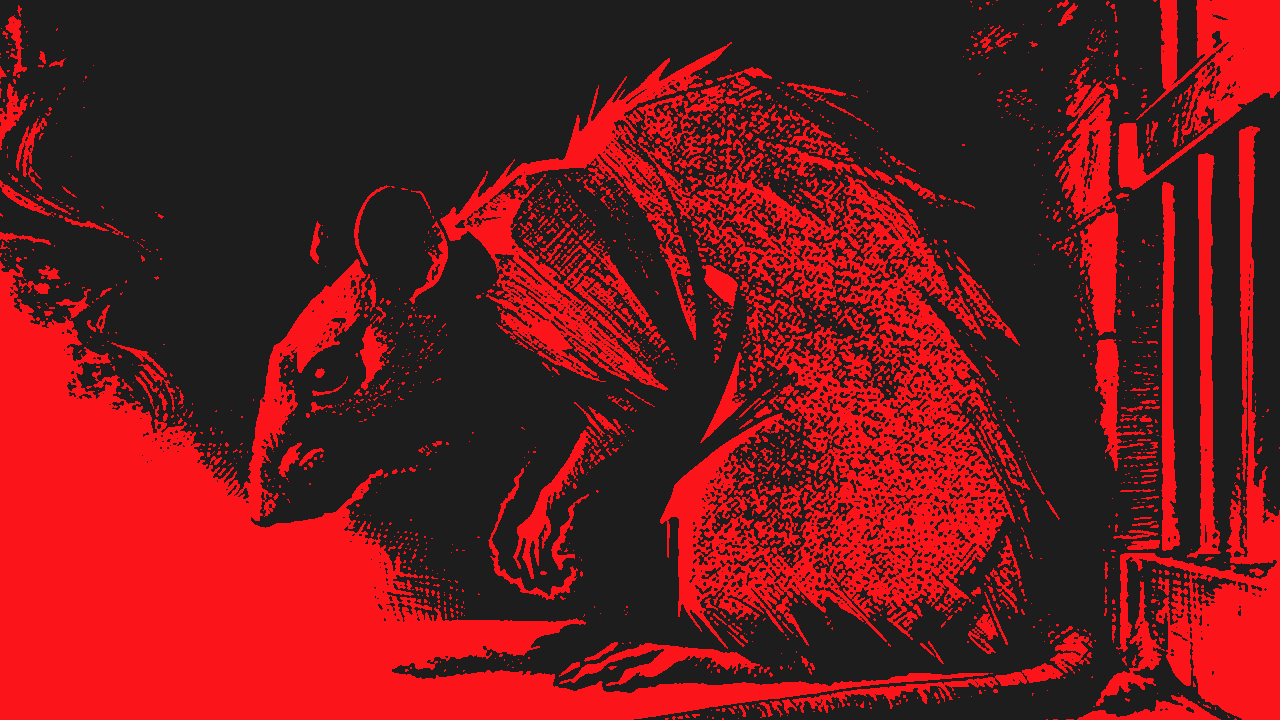
Suddenly something darted out of the burning building and sprang at Sir Joshua’s horse. It was a great black rat, and, as its teeth met in the mare’s throat, she reared on her hind legs. The knight strove to retain his seat, but he was thrown heavily to the ground. He lay there groaning, and it was evident that he had injured his back on a large stone. The servant managed to lift his master into the saddle and, with some difficulty, conveyed him back to the Hall. There he proved to be so badly bruised that he was forced to take to his bed, and lay mouthing obscene oaths and blasphemies.

At nine o’clock that same night a farmhand, going home through Loken Wood, heard a strange sound like a concourse of animals advancing through the undergrowth. The fellow, sorely frightened, climbed into the branches of a tree, and, from this safe retreat, witnessed an amazing sight. The moon was full, and, by its light, he afterwards declared he had seen thousands of rats, led by one great black monster, pass through the wood in the direction of Loken Hall.

Others, too, saw this remarkable spectacle. A stable-boy at the Hall vowed the vermin had chewed their way through a gate, and swept on across the lawns. The butler saw them swarm up the steps of the mansion, gnaw the massive oaken doors to pieces, and ascend the staircase.

It was hours before the terrified servants dared leave the kitchens to discover what had happened. Towards midnight the stable-boy arrived with the news that the army of rats had departed, and only then did some of the men summon up sufficient courage to climb the stairs. Thomas, who was the first to enter the master’s bed-chamber, collapsed before the sight which met his eyes.

Sir Joshua lay in the great bed whining and whimpering like an animal. His hands, up to the wrists, had been literally chewed away, and the bleeding stumps hung grotesquely across the stained sheets. A surgeon, hastily summoned from the village, stayed the flow of blood and bandaged the mutilated arms. But Sir Joshua lay with vacant eyes and his lips twisted into the mirthless grin of an idiot.

###

It is recorded that on Friday the 23rd of May a fire was built on Loken Green and a tall stake raised above the logs. When all was ready the beadles proceeded to the court-house to bring the prisoner forth. But Alison Joyner had disappeared. The cell was empty, save for a great black rat, which darted into a hole as the gaolers entered.

The Voice in the Night by William Hope Hodgson

It was a dark, starless night. We were becalmed in the Northern Pacific. Our exact position I do not know; for the sun had been hidden during the course of a weary, breathless week, by a thin haze which had seemed to float above us, about the height of our mastheads, at whiles descending and shrouding the surrounding sea.

With there being no wind, we had steadied the tiller, and I was the only man on deck. The crew, consisting of two men and a boy, were sleeping forrard in their den; while Will — my friend, and the master of our little craft — was aft in his bunk on the port side of the little cabin.

Suddenly, from out of the surrounding darkness, there came a hail: —

“Schooner, ahoy!”

The cry was so unexpected that I gave no immediate answer, because of my surprise.

It came again — a voice curiously throaty and inhuman, calling from somewhere upon the dark sea away on our port broadside: —

“Schooner, ahoy!”

“Hullo!” I sung out, having gathered my wits somewhat. “What are you? What do you want?”

“You need not be afraid,” answered the queer voice, having probably noticed some trace of confusion in my tone. “I am only an old — man.”

The pause sounded oddly; but it was only afterwards that it came back to me with any significance.

“Why don’t you come alongside, then?” I queried somewhat snappishly; for I liked not his hinting at my having been a trifle shaken.

“I — I — can’t. It wouldn’t be safe. I — —” The voice broke off, and there was silence.

“What do you mean?” I asked, growing more and more astonished. “Why not safe? Where are you?”

I listened for a moment; but there came no answer. And then, a sudden indefinite suspicion, of I knew not what, coming to me, I stepped swiftly to the binnacle, and took out the lighted lamp. At the same time, I knocked on the deck with my heel to waken Will. Then I was back at the side, throwing the yellow funnel of light out into the silent immensity beyond our rail. As I did so, I heard a slight, muffled cry, and then the sound of a splash, as though some one had dipped oars abruptly. Yet I cannot say that I saw anything with certainty; save, it seemed to me, that with the first flash of the light, there had been something upon the waters, where now there was nothing.

“Hullo, there!” I called. “What foolery is this!”

But there came only the indistinct sounds of a boat being pulled away into the night.

Then I heard Will’s voice, from the direction of the after scuttle: —

“What’s up, George?”

“Come here, Will!” I said.

“What is it?” he asked, coming across the deck.

I told him the queer thing which had happened. He put several questions; then, after a moment’s silence, he raised his hands to his lips, and hailed: —

“Boat, ahoy!”

From a long distance away, there came back to us a faint reply, and my companion repeated his call. Presently, after a short period of silence, there grew on our hearing the muffled sound of oars; at which Will hailed again.

This time there was a reply: —

“Put away the light.”

“I’m damned if I will,” I muttered; but Will told me to do as the voice bade, and I shoved it down under the bulwarks.

“Come nearer,” he said, and the oar-strokes continued. Then, when apparently some half-dozen fathoms distant, they again ceased.

“Come alongside,” exclaimed Will. “There’s nothing to be frightened of aboard here!”

“Promise that you will not show the light?”

“What’s to do with you,” I burst out, “that you’re so infernally afraid of the light?”

“Because — —” began the voice, and stopped short.

“Because what?” I asked, quickly.

Will put his hand on my shoulder.

“Shut up a minute, old man,” he said, in a low voice. “Let me tackle him.”

He leant more over the rail.

“See here, Mister,” he said, “this is a pretty queer business, you coming upon us like this, right out in the middle of the blessed Pacific. How are we to know what sort of a hanky-panky trick you’re up to? You say there’s only one of you. How are we to know, unless we get a squint at you — eh? What’s your objection to the light, anyway?”

As he finished, I heard the noise of the oars again, and then the voice came; but now from a greater distance, and sounding extremely hopeless and pathetic.

“I am sorry — sorry! I would not have troubled you, only I am hungry, and — so is she.”

The voice died away, and the sound of the oars, dipping irregularly, was borne to us.

“Stop!” sung out Will. “I don’t want to drive you away. Come back! We’ll keep the light hidden, if you don’t like it.”

He turned to me: —

“It’s a damned queer rig, this; but I think there’s nothing to be afraid of?”

There was a question in his tone, and I replied.

“No, I think the poor devil’s been wrecked around here, and gone crazy.”

The sound of the oars drew nearer.

“Shove that lamp back in the binnacle,” said Will; then he leaned over the rail, and listened. I replaced the lamp, and came back to his side. The dipping of the oars ceased some dozen yards distant.

“Won’t you come alongside now?” asked Will in an even voice. “I have had the lamp put back in the binnacle.”

“I — I cannot,” replied the voice. “I dare not come nearer. I dare not even pay you for the — the provisions.”

“That’s all right,” said Will, and hesitated. “You’re welcome to as much grub as you can take — —” Again he hesitated.

“You are very good,” exclaimed the voice. “May God, Who understands everything, reward you — —” It broke off huskily.

“The — the lady?” said Will, abruptly. “Is she — —”

“I have left her behind upon the island,” came the voice.

“What island?” I cut in.

“I know not its name,” returned the voice. “I would to God —— !” it began, and checked itself as suddenly.

“Could we not send a boat for her?” asked Will at this point.

“No!” said the voice, with extraordinary emphasis. “My God! No!” There was a moment’s pause; then it added, in a tone which seemed a merited reproach: —

“It was because of our want I ventured — Because her agony tortured me.”

“I am a forgetful brute,” exclaimed Will. “Just wait a minute, whoever you are, and I will bring you up something at once.”

In a couple of minutes he was back again, and his arms were full of various edibles. He paused at the rail.

“Can’t you come alongside for them?” he asked.

“No — I dare not,” replied the voice, and it seemed to me that in its tones I detected a note of stifled craving — as though the owner hushed a mortal desire. It came to me then in a flash, that the poor old creature out there in the darkness, was suffering for actual need of that which Will held in his arms; and yet, because of some unintelligible dread, refraining from dashing to the side of our little schooner, and receiving it. And with the lightning-like conviction, there came the knowledge that the Invisible was not mad; but sanely facing some intolerable horror.

“Damn it, Will!” I said, full of many feelings, over which predominated a vast sympathy. “Get a box. We must float off the stuff to him in it.”

This we did — propelling it away from the vessel, out into the darkness, by means of a boathook. In  a minute, a slight cry from the Invisible came to us, and we knew that he had secured the box.

A little later, he called out a farewell to us, and so heartful a blessing, that I am sure we were the better for it. Then, without more ado, we heard the ply of oars across the darkness.

“Pretty soon off,” remarked Will, with perhaps just a little sense of injury.

“Wait,” I replied. “I think somehow he’ll come back. He must have been badly needing that food.”

“And the lady,” said Will. For a moment he was silent; then he continued: —

“It’s the queerest thing ever I’ve tumbled across, since I’ve been fishing.”

“Yes,” I said, and fell to pondering.

And so the time slipped away — an hour, another, and still Will stayed with me; for the queer adventure had knocked all desire for sleep out of him.

The third hour was three parts through, when we heard again the sound of oars across the silent ocean.

“Listen!” said Will, a low note of excitement in his voice.

“He’s coming, just as I thought,” I muttered.

The dipping of the oars grew nearer, and I noted that the strokes were firmer and longer. The food had been needed.

They came to a stop a little distance off the broadside, and the queer voice came again to us through the darkness: —

“Schooner, ahoy!”

“That you?” asked Will.

“Yes,” replied the voice. “I left you suddenly; but — but there was great need.”

“The lady?” questioned Will.

“The — lady is grateful now on earth. She will be more grateful soon in — in heaven.”

Will began to make some reply, in a puzzled voice; but became confused, and broke off short. I said nothing. I was wondering at the curious pauses, and, apart from my wonder, I was full of a great sympathy.

The voice continued: —

“We — she and I, have talked, as we shared the result of God’s tenderness and yours — —”

Will interposed; but without coherence.

“I beg of you not to — to belittle your deed of Christian charity this night,” said the voice. “Be sure that it has not escaped His notice.”

It stopped, and there was a full minute’s silence. Then it came again: —

“We have spoken together upon that which — which has befallen us. We had thought to go out, without telling any, of the terror which has come into our — lives. She is with me in believing that to-night’s happenings are under a special ruling, and that it is God’s wish that we should tell to you all that we have suffered since — since — —”

“Yes?” said Will, softly.

“Since the sinking of the ‘Albatross.’”

“Ah!” I exclaimed, involuntarily. “She left Newcastle for ‘Frisco some six months ago, and hasn’t been heard of since.”

“Yes,” answered the voice. “But some few degrees to the North of the line she was caught in a terrible storm, and dismasted. When the day came, it was found that she was leaking badly, and, presently, it falling to a calm, the sailors took to the boats, leaving — leaving a young lady — my fiancée — and myself upon the wreck.

“We were below, gathering together a few of our belongings, when they left. They were entirely callous, through fear, and when we came up upon the decks, we saw them only as small shapes afar off upon the horizon. Yet we did not despair, but set to work and constructed a small raft. Upon this we put such few matters as it would hold, including a quantity of water and some ship’s biscuit. Then, the vessel being very deep in the water, we got ourselves on to the raft, and pushed off.

“It was later, when I observed that we seemed to be in the way of some tide or current, which bore us from the ship at an angle; so that in the course of three hours, by my watch, her hull became invisible to our sight, her broken masts remaining in view for a somewhat longer period. Then, towards evening, it grew misty, and so through the night. The next day we were still encompassed by the mist, the weather remaining quiet.

“For four days, we drifted through this strange haze, until, on the evening of the fourth day, there grew upon our ears the murmur of breakers at a distance. Gradually it became plainer, and, somewhat after midnight, it appeared to sound upon either hand at no very great space. The raft was raised upon a swell several times, and then we were in smooth water, and the noise of the breakers was behind.

“When the morning came, we found that we were in a sort of great lagoon; but of this we noticed little at the time; for close before us, through the enshrouding mist, loomed the hull of a large sailing-vessel. With one accord, we fell upon our knees and thanked God; for we thought that here was an end to our perils. We had much to learn.

“The raft drew near to the ship, and we shouted  on them, to take us aboard; but none answered. Presently, the raft touched against the side of the vessel, and, seeing a rope hanging downwards, I seized it and began to climb. Yet I had much ado to make my way up, because of a kind of grey, lichenous fungus, which had seized upon the rope, and which blotched the side of the ship, lividly.

“I reached the rail, and clambered over it, on to the deck. Here, I saw that the decks were covered, in great patches, with the grey masses, some of them rising into nodules several feet in height; but at the time, I thought less of this matter than of the possibility of there being people aboard the ship. I shouted; but none answered. Then I went to the door below the poop deck. I opened it, and peered in. There was a great smell of staleness, so that I knew in a moment that nothing living was within, and with the knowledge, I shut the door quickly; for I felt suddenly lonely.

“I went back to the side, where I had scrambled up. My — my sweetheart was still sitting quietly upon the raft. Seeing me look down, she called up to know whether there were any aboard of the ship. I replied that the vessel had the appearance of having been long deserted; but that if she would wait a little, I would see whether there was anything in the shape of a ladder, by which she could ascend to the deck. Then we would make a search through the vessel together. A little later, on the opposite side of the decks, I found a rope side-ladder. This I carried across, and a minute afterwards, she was beside me.

“Together, we explored the cabins and apartments in the after-part of the ship; but nowhere was there any sign of life. Here and there, within the cabins themselves, we came across odd patches of that  queer fungus; but this, as my sweetheart said, could be cleansed away.

“In the end, having assured ourselves that the after portion of the vessel was empty, we picked our ways to the bows, between the ugly grey nodules of that strange growth; and here we made a further search, which told us that there was indeed none aboard but ourselves.

“This being now beyond any doubt, we returned to the stern of the ship, and proceeded to make ourselves as comfortable as possible. Together, we cleared out and cleaned two of the cabins; and, after that, I made examination whether there was anything eatable in the ship. This I soon found was so, and thanked God in my heart for His goodness. In addition to this, I discovered the whereabouts of the freshwater pump, and having fixed it, I found the water drinkable, though somewhat unpleasant to the taste.

“For several days, we stayed aboard the ship, without attempting to get to the shore. We were busily engaged in making the place habitable. Yet even thus early, we became aware that our lot was even less to be desired than might have been imagined; for though, as a first step, we scraped away the odd patches of growth that studded the floors and walls of the cabins and saloon, yet they returned almost to their original size within the space of twenty-four hours, which not only discouraged us, but gave us a feeling of vague unease.

“Still, we would not admit ourselves beaten, so set to work afresh, and not only scraped away the fungus, but soaked the places where it had been, with carbolic, a can-full of which I had found in the pantry. Yet, by the end of the week, the growth had returned in full strength, and, in addition, it  had spread to other places, as though our touching it had allowed germs from it to travel elsewhere.

“On the seventh morning, my sweetheart woke to find a small patch of it growing on her pillow, close to her face. At that, she came to me, so soon as she could get her garments upon her. I was in the galley at the time, lighting the fire for breakfast.

“‘Come here, John,’ she said, and led me aft. When I saw the thing upon her pillow, I shuddered, and then and there we agreed to go right out of the ship, and see whether we could not fare to make ourselves more comfortable ashore.

“Hurriedly, we gathered together our few belongings, and even among these, I found that the fungus had been at work; for one of her shawls had a little lump of it growing near one edge. I threw the whole thing over the side, without saying anything to her.

“The raft was still alongside; but it was too clumsy to guide, and I lowered down a small boat that hung across the stern, and in this we made our way to the shore. Yet, as we drew near to it, I became gradually aware that here the vile fungus, which had driven us from the ship, was growing riot. In places it rose into horrible, fantastic mounds, which seemed almost to quiver, as with a quiet life, when the wind blew across them. Here and there, it took on the forms of vast fingers, and in others it just spread out flat and smooth and treacherous. Odd places, it appeared as grotesque stunted trees, seeming extraordinarily kinked and gnarled —— The whole quaking vilely at times.

“At first, it seemed to us that there was no single portion of the surrounding shore which was not hidden beneath the masses of the hideous lichen; yet, in this, I found we were mistaken; for somewhat  later, coasting along the shore at a little distance, we descried a smooth white patch of what appeared to be find sand, and there we landed. It was not sand. What it was, I do not know. All that I have observed, is that upon it, the fungus will not grow; while everywhere else, save where the sand-like earth wanders oddly, path-wise, amid the grey desolation of the lichen, there is nothing but that loathsome greyness.

“It is difficult to make you understand how cheered we were to find one place that was absolutely free from the growth, and here we deposited our belongings. Then we went back to the ship for such things as it seemed to us we should need. Among other matters, I managed to bring ashore with me one of the ship’s sails, with which I constructed two small tents, which, though exceedingly rough-shaped, served the purposes for which they were intended. In these, we lived and stored our various necessities, and thus for a matter of some four weeks, all went smoothly and without particular unhappiness. Indeed, I may say with much of happiness —— for — for we were together.

“It was on the thumb of her right hand, that the growth first showed. It was only a small circular spot, much like a little grey mole. My God! how the fear leapt to my heart when she showed me the place. We cleansed it, between us, washing it with carbolic and water. In the morning of the following day, she showed her hand to me again. The grey warty thing had returned. For a little while, we looked at one another in silence. Then, still wordless, we started again to remove it. In the midst of the operation, she spoke suddenly.

“What’s that on the side of your face, Dear!” Her voice was sharp with anxiety. I put my hand up to feel.

“‘There! Under the hair by your ear. — A little to the front a bit.’ My finger rested upon the place, and then I knew.

“‘Let us get your thumb done first,’ I said. And she submitted, only because she was afraid to touch me until it was cleansed. I finished washing and disinfecting her thumb, and then she turned to my face. After it was finished, we sat together and talked awhile of many things; for there had come into our lives sudden, very terrible thoughts. We were, all at once, afraid of something worse than death. We spoke of loading the boat with provisions and water, and making our way out on to the sea; yet we were helpless, for many causes, and — and the growth had attacked us already. We decided to stay. God would do with us what was His will. We would wait.

“A month, two months, three months passed, and the places grew somewhat, and there had come others. Yet we fought so strenuously with the fear, that its headway was but slow, comparatively speaking.

“Occasionally, we ventured off to the ship for such stores as we needed. There, we found that the fungus grew persistently. One of the nodules on the maindeck became soon as high as my head.

“We had now given up all thought or hope of leaving the island. We had realised that it would be unallowable to go among healthy humans, with the thing from which we were suffering.

“With this determination and knowledge in our minds, we knew that we should have to husband our food and water; for we did not know, at that time, but that we should possibly live for many years.

“This reminds me that I have told you that I am  an old man. Judged by years this is not so. But — but — —”

He broke off; then continued somewhat abruptly: —

“As I was saying, we knew that we should have to use care in the matter of food. But we had no idea then how little food there was left, of which to take care. It was a week later, that I made the discovery that all the other bread tanks — which I had supposed full — were empty, and that (beyond odd tins of vegetables and meat, and some other matters) we had nothing on which to depend, but the bread in the tank which I had already opened.

“After learning this, I bestirred myself to do what I could, and set to work at fishing in the lagoon; but with no success. At this, I was somewhat inclined to feel desperate, until the thought came to me to try outside the lagoon, in the open sea.

“Here, at times, I caught odd fish; but, so infrequently, that they proved of but little help in keeping us from the hunger which threatened. It seemed to me that our deaths were likely to come by hunger, and not by the growth of the thing which had seized upon our bodies.

“We were in this state of mind when the fourth month wore out. Then I made a very horrible discovery. One morning, a little before midday, I came off from the ship, with a portion of the biscuits which were left. In the mouth of her tent, I saw my sweetheart sitting, eating something.

“‘What is it, my Dear?’ I called out as I leapt ashore. Yet, on hearing my voice, she seemed confused, and, turning, slyly threw something towards the edge of the little clearing. It fell short, and, a vague suspicion having arisen within me, I walked across and picked it up. It was a piece of the grey fungus.

“As I went to her, with it in my hand, she turned deadly pale; then a rose red.

“I felt strangely dazed and frightened.

“‘My Dear! My Dear!’ I said, and could say no more. Yet, at my words, she broke down and cried bitterly. Gradually, as she calmed, I got from her the news that she had tried it the preceding day, and — and liked it. I got her to promise on her knees not to touch it again, however great our hunger. After she had promised, she told me that the desire for it had come suddenly, and that, until the moment of desire, she had experienced nothing towards it, but the most extreme repulsion.

“Later in the day, feeling strangely restless, and much shaken with the thing which I had discovered, I made my way along one of the twisted paths — formed by the white, sand-like substance — which led among the fungoid growth. I had, once before, ventured along there; but not to any great distance. This time, being involved in perplexing thought, I went much further than hitherto.

“Suddenly, I was called to myself, by a queer hoarse sound on my left. Turning quickly, I saw that there was movement among an extraordinarily shaped mass of fungus, close to my elbow. It was swaying uneasily, as though it possessed life of its own. Abruptly, as I stared, the thought came to me that the thing had a grotesque resemblance to the figure of a distorted human creature. Even as the fancy flashed into my brain, there was a slight, sickening noise of tearing, and I saw that one of the branch-like arms was detaching itself from the surrounding grey masses, and coming towards me. The head of the thing — a shapeless grey ball, inclined in my direction. I stood stupidly, and the vile arm brushed  across my face. I gave out a frightened cry, and ran back a few paces. There was a sweetish taste upon my lips, where the thing had touched me. I licked them, and was immediately filled with an inhuman desire. I turned and seized a mass of the fungus. Then more, and — more. I was insatiable. In the midst of devouring, the remembrance of the morning’s discovery swept into my mazed brain. It was sent by God. I dashed the fragment I held, to the ground. Then, utterly wretched and feeling a dreadful guiltiness, I made my way back to the little encampment.

“I think she knew, by some marvellous intuition which love must have given, so soon as she set eyes on me. Her quiet sympathy made it easier for me, and I told her of my sudden weakness; yet omitted to mention the extraordinary thing which had gone before. I desired to spare her all unnecessary terror.

“But, for myself, I had added an intolerable knowledge, to breed an incessant terror in my brain; for I doubted not but that I had seen the end of one of those men who had come to the island in the ship in the lagoon; and in that monstrous ending, I had seen our own.

“Thereafter, we kept from the abominable food, though the desire for it had entered into our blood. Yet, our drear punishment was upon us; for, day by day, with monstrous rapidity, the fungoid growth took hold of our poor bodies. Nothing we could do would check it materially, and so — and so — we who had been human, became — Well, it matters less each day. Only — only we had been man and maid!

“And day by day, the fight is more dreadful, to withstand the hunger-lust for the terrible lichen.

“A week ago we ate the last of the biscuit, and  since that time I have caught three fish. I was out here fishing to-night, when your schooner drifted upon me out of the mist. I hailed you. You know the rest, and may God, out of His great heart, bless you for your goodness to a — a couple of poor outcast souls.”

There was the dip of an oar — another. Then the voice came again, and for the last time, sounding through the slight surrounding mist, ghostly and mournful.

“God bless you! Good-bye!”

“Good-bye,” we shouted together, hoarsely, our hearts full of many emotions.

I glanced about me. I became aware that the dawn was upon us.

The sun flung a stray beam across the hidden sea; pierced the mist dully, and lit up the receding boat with a gloomy fire. Indistinctly, I saw something nodding between the oars. I thought of a sponge — a great, grey nodding sponge —— The oars continued to ply. They were grey — as was the boat — and my eyes searched a moment vainly for the conjunction of hand and oar. My gaze flashed back to the — head. It nodded forward as the oars went backward for the stroke. Then the oars were dipped, the boat shot out of the patch of light, and the — the thing went nodding into the mist.

The House of the Nightmare by Edward Lucas White

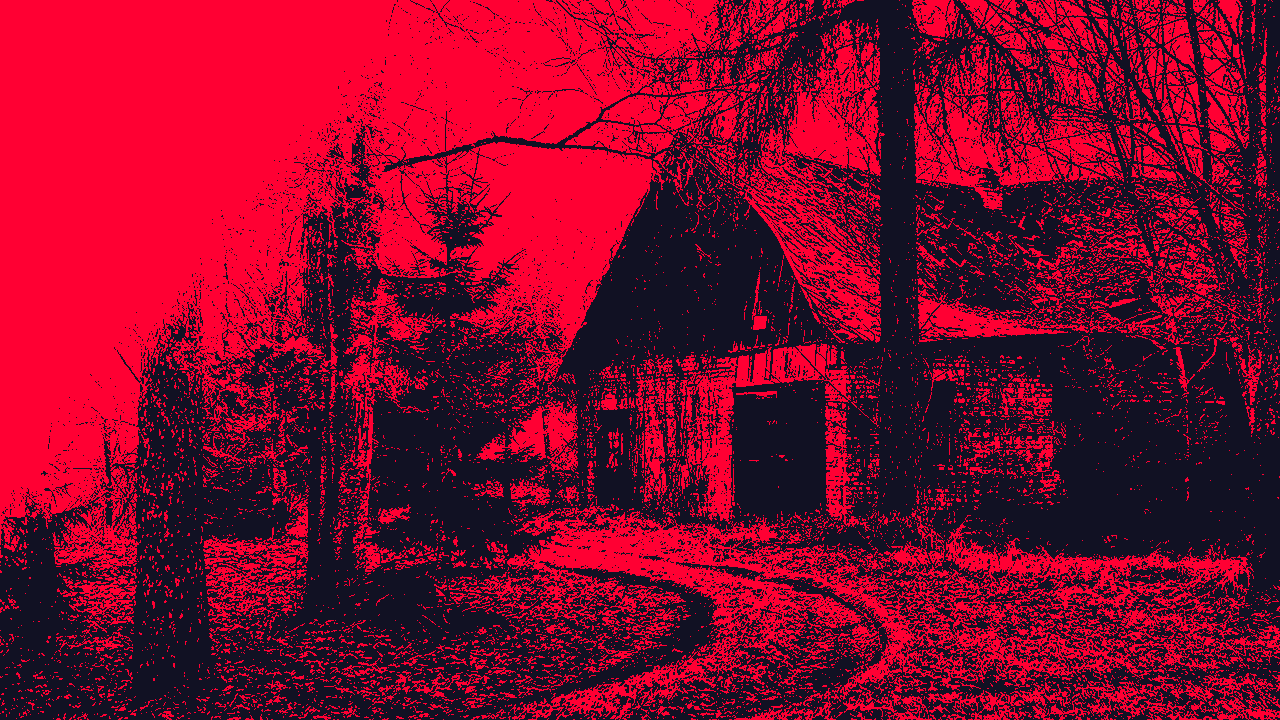
I FIRST caught sight of the house from the brow of the mountain as I cleared the woods and looked across the broad valley several hundred feet below me, to the low sun sinking toward the far blue hills. From that momentary viewpoint I had an exaggerated sense of looking almost vertically down. I seemed to be hanging over the checkerboard of roads and fields, dotted with farm buildings, and felt the familiar deception that I could almost throw a stone upon the house. I barely glimpsed its slate roof.

What caught my eyes was the bit of road in front of it, between the mass of dark-green shade trees about the house and the orchard opposite. Perfectly straight it was, bordered by an even row of trees, through which I made out a cinder side path and a low stone wall.

Conspicuous on the orchard side between two of the flanking trees was a white object, which I took to be a tall stone, a vertical splinter of one of the tilted lime-stone reefs with which the fields of the region are scarred.

The road itself I saw plain as a box-wood ruler on a green baize table. It gave me a pleasurable anticipation of a chance for a burst of speed. I had been painfully traversing closely forested, semi-mountainous hills. Not a farmhouse had I passed, only wretched cabins by the road, more than twenty miles of which I had found very bad and hindering. Now, when I was not many miles from my expected stopping-place, I looked forward to better going, and to that straight, level bit in particular.

As I sped cautiously down the sharp beginning of the long descent the trees engulfed me again, and I lost sight of the valley. I dipped into a hollow, rose on the crest of the next hill, and again saw the house, nearer, and not so far below.

The tall stone caught my eye with a shock of surprise. Had I not thought it was opposite the house next the orchard? Clearly it was on the left-hand side of the road toward the house. My self-questioning lasted only the moment as I passed the crest. Then the outlook was cut off again; but I found myself gazing ahead, watching for the next chance at the same view.

At the end of the second hill I only saw the bit of road obliquely and could not be sure, but, as at first, the tall stone seemed on the right of the road.

At the top of the third and last hill I looked down the stretch of road under the overarching trees, almost as one would look through a tube. There was a line of whiteness which I took for the tall stone. It was on the right.

I dipped into the last hollow. As I mounted the farther slope I kept my eyes on the top of the road ahead of me. When my line of sight surmounted the rise I marked the tall stone on my right hand among the serried maples. I leaned over, first on one side, then on the other, to inspect my tires, then I threw the lever.

As I flew forward I looked ahead. There was the tall stone—on the left of the road! I was really scared and almost dazed. I meant to stop dead, take a good look at the stone, and make up my mind beyond peradventure whether it was on the right or the left—if not, indeed, in the middle of the road.

In my bewilderment I put on the highest speed. The machine leaped forward; everything I touched went wrong; I steered wildly, slewed to my left, and crashed into a big maple.

When I came to my senses I was flat on my back in the dry gulch. The last rays of the sun sent shafts of golden green light through the maple boughs overhead. My first thought was an odd mixture of appreciation of the beauties of nature and disapproval of my own conduct in touring without a companion—a fad I had regretted more than once. Then my mind cleared and I sat up. I felt myself from the head down. I was not bleeding; no bones were broken; and, while much shaken, I had suffered no serious bruises.

Then I saw the boy. He was standing at the edge of the cinder-path, near the ditch. He was stocky and solidly built; barefoot, with his trousers rolled up to his knees; wore a sort of butternut shirt, open at the throat; and was coatless and hatless. He was tow-headed, with a shock of tousled hair; was much freckled, and had a hideous harelip. He shifted from one foot to the other, twiddled his toes, and said nothing whatever, though he stared at me intently.

I scrambled to my feet and proceeded to survey the wreck. It seemed distressingly complete. It had not blown up, nor even caught fire; but otherwise the ruin appeared hopelessly thorough. Everything I examined seemed worse smashed than the rest. My two hampers alone, by one of those cynical jokes of chance, had escaped—both had pitched clear of the wreckage and were unhurt, not even a bottle broken.

During my investigations the boy’s faded eyes followed me continuously, but he uttered no word. When I had convinced myself of my helplessness I straightened up and addressed him:

“How far is it to a blacksmith’s shop?”

“Eight mile,” he answered. He had a distressing case of cleft palate and was scarcely intelligible.

“Can you drive me there?” I inquired.

“Nary team on the place,” he replied; “nary horse, nary cow.”

“How far to the next house?” I continued.

“Six mile,” he responded.

I glanced at the sky. The sun had set already. I looked at my watch: it was going—seven thirty-six.

“May I sleep in your house tonight?” I asked.

“You can come in if you want to,” he said, “and sleep if you can. House all messy; ma’s been dead three year, and dad’s away. Nothin’ to eat but buckwheat flour and rusty bacon.”

“I’ve plenty to eat,” I answered, picking up a hamper. “Just take that hamper, will you?”

“You can come in if you’re a mind to,” he said, “but you got to carry your own stuff.” He did not speak gruffly or rudely, but appeared mildly stating an inoffensive fact.

“All right,” I said, picking up the other hamper; “lead the way.”

The yard in front of the house was dark under a dozen or more immense ailanthus trees. Below them many smaller trees had grown up, and beneath these a dank underwood of tall, rank suckers out of the deep, shaggy, matted grass. What had once been, apparently, a carriage-drive left a narrow, curved track, disused and grass-grown, leading to the house. Even here were some shoots of the ailanthus, and the air was unpleasant with the vile smell of the roots and suckers and the insistent odor of their flowers.

The house was of grey stone, with green shutters faded almost as gray as the stone. Along its front was a veranda, not much raised from the ground, and with no balustrade or railing. On it were several hickory splint rockers. There were eight shuttered windows toward the porch, and midway of them a wide door, with small violet panes on either side of it and a fanlight above.

“Open the door,” I said to the boy.

“Open it yourself,” he replied, not unpleasantly nor disagreeably, but in such a tone that one could not but take the suggestion as a matter of course.

I put down the two hampers and tried the door. It was latched, but not locked, and opened with a rusty grind of its hinges, on which it sagged crazily, scraping the floor as it turned. The passage smelt moldy and damp. There were several doors on either side; the boy pointed to the first on the right.

“You can have that room,” he said.

I opened the door. What with the dusk, the interlacing trees outside, the piazza roof, and the closed shutters, I could make out little.

“Better get a lamp,” I said to the boy.

“Nary lamp,” he declared cheerfully. “Nary candle. Mostly I get abed before dark.”

I returned to the remains of my conveyance. All four of my lamps were merely scrap metal and splintered glass. My lantern was mashed flat. I always, however, carried candles in my valise. This I found split and crushed, but still holding together. I carried it to the porch, opened it, and took out three candles.

Entering the room, where I found the boy standing just where I had left him, I lit the candle. The walls were white-washed, the floor bare. There was a mildewed, chilly smell, but the bed looked freshly made up and clean, although it felt clammy.

With a few drops of its own grease I stuck the candle on the corner of a mean, rickety little bureau. There was nothing else in the room save two rush-bottomed chairs and a small table. I went out on the porch, brought in my valise, and put it on the bed. I raised the sash of each window and pushed open the shutters. Then I asked the boy, who had not moved or spoken, to show me the way to the kitchen. He led me straight through the hall to the back of the house. The kitchen was large, and had no furniture save some pine chairs, a pine bench, and a pine table.

I stuck two candles on opposite corners of the table. There was no stove or range in the kitchen, only a big hearth, the ashes in which smelt and looked a month old. The wood in the woodshed was dry enough, but even it had a cellary, stale smell. The ax and hatchet were both rusty and dull, but usable, and I quickly made a big fire. To my amazement, for the mid-June evening was hot and still, the boy, a wry smile on his ugly face, almost leaned over the flame, hands and arms spread out, and fairly roasted himself.

“Are you cold?” I inquired.

“I’m allus cold,” he replied, hugging the fire closer than ever, till I thought he must scorch.

I left him toasting himself while I went in search of water. I discovered the pump, which was in working order and not dry on the valves; but I had a furious struggle to fill the two leaky pails I had found. When I had put water to boil I fetched my hampers from the porch.

I brushed the table and set out my meal—cold fowl, cold ham, white and brown bread, olives, jam, and cake. When the can of soup was hot and the coffee made I drew up two chairs to the table and invited the boy to join me.

“I ain’t hungry,” he said; “I’ve had supper.”

He was a new sort of boy to me; all the boys I knew were hearty eaters and always ready. I had felt hungry myself, but somehow when I came to eat I had little appetite and hardly relished the food. I soon made an end of my meal, covered the fire, blew out the candles, and returned to the porch, where I dropped into one of the hickory rockers to smoke. The boy followed me silently and seated himself on the porch floor, leaning against a pillar, his feet on the grass outside.

“What do you do,” I asked, “when your father is away?”

“Just loaf ’round,” he said. “Just fool ’round.”

“How far off are your nearest neighbors?” I asked.

“Don’t no neighbors never come here,” he stated. “Say they’re afeared of the ghosts.”

I was not at all startled; the place had all those aspects which lead to a house being called haunted. I was struck by his odd matter-of-fact way of speaking—it was as if he had said they were afraid of a cross dog.

“Do you ever see any ghosts around here?” I continued.

“Never see ’em,” he answered, as if I had mentioned tramps or partridges. “Never hear ’em. Sort o’ feel ’em ’round sometimes.”

“Are you afraid of them?” I asked.

“Nope,” he declared. “I ain’t skeered o’ ghosts; I’m skeered o’ nightmares. Ever have nightmares?”

“Very seldom,” I replied.

“I do,” he returned. “Allus have the same nightmare—big sow, big as a steer, trying to eat me up. Wake up so skeered I could run to never. Nowheres to run to. Go to sleep, and have it again. Wake up worse skeered than ever. Dad says it’s buckwheat cakes in summer.”

“You must have teased a sow some time,” I said.

“Yep,” he answered. “Teased a big sow wunst, holding up one of her pigs by the hind leg. Teased her too long. Fell in the pen and got bit up some. Wisht I hadn’t ’a’ teased her. Have that nightmare three times a week sometimes. Worse’n being burnt out. Worse’n ghosts. Say, I sorter feel ghosts around now.”

He was not trying to frighten me. He was as simply stating an opinion as if he had spoken of bats or mosquitoes. I made no reply, and found myself listening involuntarily. My pipe went out. I did not really want another, but felt disinclined for bed as yet, and was comfortable where I was, while the smell of the ailanthus blossoms was very disagreeable. I filled my pipe again, lit it, and then, as I puffed, somehow dozed off for a moment.

I awoke with a sensation of some light fabric trailed across my face. The boy’s position was unchanged.

“Did you do that?” I asked sharply.

“Ain’t done nary thing,” he rejoined. “What was it?”

“It was like a piece of mosquito-netting brushed over my face.”

“That ain’t netting,” he asserted; “that’s a veil. That’s one of the ghosts. Some blow on you; some touch you with their long, cold fingers. That one with the veil she drags acrosst your face—well, mostly I think it’s ma.”

He spoke with the unassailable conviction of the child in “We Are Seven.” I found no words to reply, and rose to go to bed.

“Good night,” I said.

“Good night,” he echoed. “I’ll set out here a spell yet.”

I lit a match, found the candle I had stuck on the corner of the shabby little bureau, and undressed. The bed had a comfortable husk mattress, and I was soon asleep.

I had the sensation of having slept some time when I had a nightmare—the very nightmare the boy had described. A huge sow, big as a dray horse, was reared up on her forelegs over the foot-board of the bed, trying to scramble over to me. She grunted and puffed, and I felt I was the food she craved. I knew in the dream that it was only a dream, and strove to wake up.

Then the gigantic dream-beast floundered over the foot-board, fell across my shins, and I awoke.

I was in darkness as absolute as if I were sealed in a jet vault, yet the shudder of the nightmare instantly subsided, my nerves quieted; I realized where I was, and felt not the least panic. I turned over and was asleep again almost at once. Then I had a real nightmare, not recognizable as a dream, but appallingly real—an unutterable agony of reasonless horror.

There was a Thing in the room; not a sow, nor any other namable creature, but a Thing. It was as big as an elephant, filled the room to the ceiling, was shaped like a wild boar, seated on its haunches, with its forelegs braced stiffly in front of it. It had a hot, slobbering, red mouth, full of big tusks, and its jaws worked hungrily. It shuffled and hunched itself forward, inch by inch, till its vast forelegs straddled the bed.

The bed crushed up like wet blotting-paper, and I felt the weight of the Thing on my feet, on my legs, on my body, on my chest. It was hungry, and I was what it was hungry for, and it meant to begin on my face. Its dripping mouth was nearer and nearer.

Then the dream-helplessness that made me unable to call or move suddenly gave way, and I yelled and awoke. This time my terror was positive and not to be shaken off.

It was near dawn: I could descry dimly the cracked, dirty window-panes. I got up, lit the stump of my candle and two fresh ones, dressed hastily, strapped my ruined valise, and put it on the porch against the wall near the door. Then I called the boy. I realized quite suddenly that I had not told him my name or asked his.

I shouted “Hello!” a few times, but won no answer. I had had enough of that house. I was still permeated with the panic of the nightmare. I desisted from shouting, made no search, but with two candles went out to the kitchen. I took a swallow of cold coffee and munched a biscuit as I hustled my belongings into my hampers. Then, leaving a silver dollar on the table, I carried the hampers out on the porch and dumped them by my valise.

It was now light enough to see to walk, and I went out to the road. Already the night-dew had rusted much of the wreck, making it look more hopeless than before. It was, however, entirely undisturbed. There was not so much as a wheel-track or a hoof-print on the road. The tall, white stone, uncertainty about which had caused my disaster, stood like a sentinel opposite where I had upset.

I set out to find that blacksmith shop. Before I had gone far the sun rose clear from the horizon, and almost at once scorching. As I footed it along I grew very much heated, and it seemed more like ten miles than six before I reached the first house. It was a new frame house, neatly painted and close to the road, with a whitewashed fence along its garden front.

I was about to open the gate when a big black dog with a curly tail bounded out of the bushes. He did not bark, but stood inside the gate wagging his tail and regarding me with a friendly eye; yet I hesitated with my hand on the latch, and considered. The dog might not be as friendly as he looked, and the sight of him made me realize that except for the boy I had seen no creature about the house where I had spent the night; no dog or cat; not even a toad or bird. While I was ruminating upon this a man came from behind the house.

“Will your dog bite?” I asked.

“Naw,” he answered; “he don’t bite. Come in.”

I told him I had had an accident to my automobile, and asked if he could drive me to the blacksmith shop and back to my wreckage.

“Cert,” he said. “Happy to help you. I’ll hitch up foreshortly. Wher’d you smash?”

“In front of the gray house about six miles back,” I answered.

“That big stone-built house?” he queried.

“The same,” I assented.

“Did you go a-past here?” he inquired astonished. “I didn’t hear ye.”

“No,” I said; “I came from the other direction.”

“Why,” he meditated, “you must ’a’ smashed ’bout sunup. Did you come over them mountains in the dark?”

“No,” I replied; “I came over them yesterday evening. I smashed up about sunset.”

“Sundown!” he exclaimed. “Where in thunder’ve you been all night?”

“I slept in the house where I broke down.”

“In that there big stone-built house in the trees?” he demanded.

“Yes,” I agreed.

“Why,” he quavered excitedly, “that there house is haunted! They say if you have to drive past it after dark, you can’t tell which side of the road the big white stone is on.”

“I couldn’t tell even before sunset,” I said.

“There!” he exclaimed. “Look at that, now! And you slep’ in that house! Did you sleep, honest?”

“I slept pretty well,” I said. “Except for a nightmare, I slept all night.”

“Well,” he commented, “I wouldn’t go in that there house for a farm, nor sleep in it for my salvation. And you slep’! How in thunder did you get in?”

“The boy took me in,” I said.

“What sort of a boy?” he queried, his eyes fixed on me with a queer, countrified look of absorbed interest.

“A thick-set, freckle-faced boy with a harelip,” I said.

“Talk like his mouth was full of mush?” he demanded.

“Yes,” I said; “bad case of cleft palate.”

“Well!” he exclaimed. “I never did believe in ghosts, and I never did half believe that house was haunted, but I know it now. And you slep’!”

“I didn’t see any ghosts,” I retorted irritably.

“You seen a ghost for sure,” he rejoined solemnly. “That there harelip boy’s been dead six months.”

##

The Crooked Mirror by Anton Chekhov

We went into the reception hall, my wife and I. It smelled of moss and damp. Hordes of rats and mice leaped aside as we brought light to walls that had not seen it for a century. As we shut the door behind us, a puff of wind rustled papers piled in corners; light fell on them and we noticed ancient lettering and medieval pictures. On walls green with age hung portraits of my ancestors. They stared down, stern and disdainful, as if about to say:

“A whipping for you, my man!”

Our steps resounded through the building. I coughed and there came an echo, the very one that replied once to my ancestors…

And the wind moaned and howled. There was a sobbing in the chimney stack like someone in despair, and big drops of rain beat a melancholy patter on the glimmering windows.

“Oh, ancestors of mine,” I murmured with a sigh, “if I were a writer, looking at your portraits, I could write a long novel. For each of these old people was young once and each man or woman of them was a fitting subject. And what a story it would be! Look, say, at that old lady, my great-grandmother. That ugly misshapen woman had a remarkable history.”

“Do you see the mirror,” I asked my wife, “do you see it, hanging there in the corner?”

And I pointed out to her a large mirror in a frame of blackened bronze that hung in a corner near the portrait of my great-grandmother.

“That mirror has magic powers: it was the ruin of my great-grandmother. For it she paid an enormous sum and she did not part with it until the moment of her death. Day and night, incessantly, she looked into it, looked even when she ate and drank. As she went to sleep, she laid the mirror by her in the bed and, dying, begged that it be laid beside her in the coffin. It was only because it would not fit into the coffin that her wish was unfulfilled.”

“She was a vain coquette, wasn’t she?” said my wife.

“I admit it. But hadn’t she other mirrors, then? Why was it just that mirror that she loved and not another? Hadn’t she better mirrors even? No, my dear, some terrible secret is hidden there. How else do you explain it? Legend has it there’s a devil in the mirror and that my great-grandmother was fascinated by devils.”

I brushed dust from the mirror, looked into it and began to laugh. A dull echo replied. It was a crooked mirror that twisted my features in all directions: my nose appeared on my left cheek and my chin was cleft and turned askew.

“What strange tastes my great-grandmother had!” I said.

My wife went hesitantly to the mirror and she too glanced there-and at once a terrible thing happened. She went pale, trembled all over and cried out. The candlestick dropped from her hand and rolled on the floor and the candle went out. Darkness closed over us.

And at that very moment I heard something heavy falling: my wife had lost consciousness.

The wind moaned on as sadly as ever, rats scampered, mice rustled among the papers. The hairs bristled and stirred on my head as a shutter broke from a window and clattered down, and the moon came into view. . .

I lifted my wife in my arms and carried her from the house of my ancestors. And it was not till the evening of the next day that she came to herself.

“The mirror! Give me the mirror!” she said. “Where is the mirror?”

For a full week afterwards she neither ate nor drank nor slept and all the time kept asking for the mirror to be brought to her. She sobbed, tore her hair and tossed to and fro till at last, when the doctor said she might die of exhaustion, her condition being extremely grave, I mastered my fear and went down there again and brought back for her the mirror of my great-grandmother. As she saw it, she laughed with joy, then clutched at it and kissed it, and devoured it with her eyes.

#

More than ten years have passed by since then and still she stares incessantly into the mirror, not turning away an instant.

“Is it really me?” she whispers and her face, as she blushes, shines with serene delight. “Yes, it is! All things tell lies to me except this mirror. People lie, my husband lies. Oh, if only I had seen myself earlier, I would have known what I truly am and would never have married that man! He is quite unworthy of me. The most handsome and noble of knights should be at my feet.”

Once, as I stood behind my wife, I glanced inadvertantly into the mirror- and learned a terrible secret. I saw there a woman of such dazzling beauty as I have never seen in all my life, a wonder of nature, a figure of comeliness, grace and love.

How can I explain it? What had happened? Why did my ugly lumbering wife look so lovely in the mirror? Why?

Because, indeed, the distorting mirror distorted every line of my wife’s ugly face and by this changing of the features chanced to make it beautiful. A minus times a minus is a plus.

And now both of us, my wife and I, sit at the mirror, not turning away an instant, looking: my nose twists up my left cheek, my chin is cleft and turned askew but my wife’s face is fascinating – and an insane passion overcomes me.

“Ha, ha, ha!”

I laugh savagely. And my wife whispers, scarcely heard.

“How lovely I am!”

##

Editor’s Note

Chekhov deserves the accolades he gets for being the most important short story writer of all time. Here, he ventures into the horror sphere (albeit slightly) and I took the opportunity to post it.

Interview with J Nathan

After posting the amazing story The Fun Times Gal of Rockway Boulevard, we sat down to ask J Nathan her thoughts on the writing of the tale. There may be spoilers ahead!

Q1. I love the narrative voice of this one. I feel like I’m right there with our ‘fun gal’. Did you spend a lot of time thinking about how you’d achieve this or did it come naturally?  

I have spent a good part of my life (20 years) in the theatre world working as a director, designer, and sometimes playwright. This story is essentially a monologue. Once I figured out what kind of girl Anna was, it just flowed. I think it took me less than two weeks to write this start to finish, which is very fast for me.

Q2. We know nothing about the person the fun gal is talking to. Was this a conscious choice? 

Yes. I wanted the reader to be in the driver’s seat, be who Anna is talking to. The Phantom Hitchhiker is my favorite urban legend, and I often wonder what it would be like to pick up a ghost on the side of the road. This story is, in part, exploration of that idea.

Q3. Who are your biggest inspirations and did any of them have a hand in what you’ve accomplished here?   

Shirley Jackson, Ursula K. Le Guin, Alice Hoffman, Wendy N. Wagner, Chloe N. Clark, Stephen King, Chuck Wendig…so many wonderful writers inspire my writing.

Shirley Jackson was a huge influence for this story. She writes wonderful unreliable narrators that the audience connects with. Eleanor Vance and Merricat Blackwood have really stuck with me.

Q4. How much of your time do you spend writing short stories versus other projects?

I probably write about 10 hours a week. The rest of my free time I spent outside away from screens—gardening, trail running, or just reading on the deck.

Q5. What other works do you have on the go? Anything you’d like to promote?

I have about 10 short stories floating around the publishing world waiting to be snatched up for publication.

Stories I have out currently include:

Cozy Fantasy: Hoofbeats at Inner Worlds

https://inner-worlds.ghost.io/issue-9-hoofbeats-by-j-nathan/

Weird West: Will Purdy and the Sky at Pulp Asylum

https://www.pulpasylum.com/will-purdy-and-the-sky-by-j-nathan.html

Horror: The Majestic in the Back Into the Ground Anthology

https://www.amazon.com/Back-Into-Ground-Anthology-Northwest-ebook/dp/B0FCCZS38Y

Sredni Vashtar by Saki

Conradin was ten years old, and the doctor had pronounced his professional opinion that the boy would not live another five years. The doctor was silky and effete, and counted for little, but his opinion was endorsed by Mrs. De Ropp, who counted for nearly everything. Mrs. De Ropp was Conradin’s cousin and guardian, and in his eyes she represented those three-fifths of the world that are necessary and disagreeable and real; the other two-fifths, in perpetual antagonism to the foregoing, were summed up in himself and his imagination. One of these days Conradin supposed he would succumb to the mastering pressure of wearisome necessary things—such as illnesses and coddling restrictions and drawn-out dulness. Without his imagination, which was rampant under the spur of loneliness, he would have succumbed long ago.

Mrs. De Ropp would never, in her honestest moments, have confessed to herself that she disliked Conradin, though she might have been dimly aware that thwarting him “for his good” was a duty which she did not find particularly irksome. Conradin hated her with a desperate sincerity which he was perfectly able to mask. Such few pleasures as he could contrive for himself gained an added relish from the likelihood that they would be displeasing to his guardian, and from the realm of his imagination she was locked out—an unclean thing, which should find no entrance.

In the dull, cheerless garden, overlooked by so many windows that were ready to open with a message not to do this or that, or a reminder that medicines were due, he found little attraction. The few fruit-trees that it contained were set jealously apart from his plucking, as though they were rare specimens of their kind blooming in an arid waste; it would probably have been difficult to find a market-gardener who would have offered ten shillings for their entire yearly produce. In a forgotten corner, however, almost hidden behind a dismal shrubbery, was a disused tool-shed of respectable proportions, and within its walls Conradin found a haven, something that took on the varying aspects of a playroom and a cathedral. He had peopled it with a legion of familiar phantoms, evoked partly from fragments of history and partly from his own brain, but it also boasted two inmates of flesh and blood. In one corner lived a ragged-plumaged Houdan hen, on which the boy lavished an affection that had scarcely another outlet. Further back in the gloom stood a large hutch, divided into two compartments, one of which was fronted with close iron bars. This was the abode of a large polecat-ferret, which a friendly butcher-boy had once smuggled, cage and all, into its present quarters, in exchange for a long-secreted hoard of small silver. Conradin was dreadfully afraid of the lithe, sharp-fanged beast, but it was his most treasured possession. Its very presence in the tool-shed was a secret and fearful joy, to be kept scrupulously from the knowledge of the Woman, as he privately dubbed his cousin. And one day, out of Heaven knows what material, he spun the beast a wonderful name, and from that moment it grew into a god and a religion. The Woman indulged in religion once a week at a church near by, and took Conradin with her, but to him the church service was an alien rite in the House of Rimmon. Every Thursday, in the dim and musty silence of the tool-shed, he worshipped with mystic and elaborate ceremonial before the wooden hutch where dwelt Sredni Vashtar, the great ferret. Red flowers in their season and scarlet berries in the winter-time were offered at his shrine, for he was a god who laid some special stress on the fierce impatient side of things, as opposed to the Woman’s religion, which, as far as Conradin could observe, went to great lengths in the contrary direction. And on great festivals powdered nutmeg was strewn in front of his hutch, an important feature of the offering being that the nutmeg had to be stolen. These festivals were of irregular occurrence, and were chiefly appointed to celebrate some passing event. On one occasion, when Mrs. De Ropp suffered from acute toothache for three days, Conradin kept up the festival during the entire three days, and almost succeeded in persuading himself that Sredni Vashtar was personally responsible for the toothache. If the malady had lasted for another day the supply of nutmeg would have given out.

The Houdan hen was never drawn into the cult of Sredni Vashtar. Conradin had long ago settled that she was an Anabaptist. He did not pretend to have the remotest knowledge as to what an Anabaptist was, but he privately hoped that it was dashing and not very respectable. Mrs. De Ropp was the ground plan on which he based and detested all respectability.

After a while Conradin’s absorption in the tool-shed began to attract the notice of his guardian. “It is not good for him to be pottering down there in all weathers,” she promptly decided, and at breakfast one morning she announced that the Houdan hen had been sold and taken away overnight. With her short-sighted eyes she peered at Conradin, waiting for an outbreak of rage and sorrow, which she was ready to rebuke with a flow of excellent precepts and reasoning. But Conradin said nothing: there was nothing to be said. Something perhaps in his white set face gave her a momentary qualm, for at tea that afternoon there was toast on the table, a delicacy which she usually banned on the ground that it was bad for him; also because the making of it “gave trouble,” a deadly offence in the middle-class feminine eye.

“I thought you liked toast,” she exclaimed, with an injured air, observing that he did not touch it.

“Sometimes,” said Conradin.

In the shed that evening there was an innovation in the worship of the hutch-god. Conradin had been wont to chant his praises, tonight he asked a boon.

“Do one thing for me, Sredni Vashtar.”

The thing was not specified. As Sredni Vashtar was a god he must be supposed to know. And choking back a sob as he looked at that other empty corner, Conradin went back to the world he so hated.

And every night, in the welcome darkness of his bedroom, and every evening in the dusk of the tool-shed, Conradin’s bitter litany went up: “Do one thing for me, Sredni Vashtar.”

Mrs. De Ropp noticed that the visits to the shed did not cease, and one day she made a further journey of inspection.

“What are you keeping in that locked hutch?” she asked. “I believe it’s guinea-pigs. I’ll have them all cleared away.”

Conradin shut his lips tight, but the Woman ransacked his bedroom till she found the carefully hidden key, and forthwith marched down to the shed to complete her discovery. It was a cold afternoon, and Conradin had been bidden to keep to the house. From the furthest window of the dining-room the door of the shed could just be seen beyond the corner of the shrubbery, and there Conradin stationed himself. He saw the Woman enter, and then he imagined her opening the door of the sacred hutch and peering down with her short-sighted eyes into the thick straw bed where his god lay hidden. Perhaps she would prod at the straw in her clumsy impatience. And Conradin fervently breathed his prayer for the last time. But he knew as he prayed that he did not believe. He knew that the Woman would come out presently with that pursed smile he loathed so well on her face, and that in an hour or two the gardener would carry away his wonderful god, a god no longer, but a simple brown ferret in a hutch. And he knew that the Woman would triumph always as she triumphed now, and that he would grow ever more sickly under her pestering and domineering and superior wisdom, till one day nothing would matter much more with him, and the doctor would be proved right. And in the sting and misery of his defeat, he began to chant loudly and defiantly the hymn of his threatened idol:


Sredni Vashtar went forth,

His thoughts were red thoughts and his teeth were white.

His enemies called for peace, but he brought them death.

Sredni Vashtar the Beautiful.

And then of a sudden he stopped his chanting and drew closer to the window-pane. The door of the shed still stood ajar as it had been left, and the minutes were slipping by. They were long minutes, but they slipped by nevertheless. He watched the starlings running and flying in little parties across the lawn; he counted them over and over again, with one eye always on that swinging door. A sour-faced maid came in to lay the table for tea, and still Conradin stood and waited and watched. Hope had crept by inches into his heart, and now a look of triumph began to blaze in his eyes that had only known the wistful patience of defeat. Under his breath, with a furtive exultation, he began once again the pæan of victory and devastation. And presently his eyes were rewarded: out through that doorway came a long, low, yellow-and-brown beast, with eyes a-blink at the waning daylight, and dark wet stains around the fur of jaws and throat. Conradin dropped on his knees. The great polecat-ferret made its way down to a small brook at the foot of the garden, drank for a moment, then crossed a little plank bridge and was lost to sight in the bushes. Such was the passing of Sredni Vashtar.

“Tea is ready,” said the sour-faced maid; “where is the mistress?”

“She went down to the shed some time ago,” said Conradin.

And while the maid went to summon her mistress to tea, Conradin fished a toasting-fork out of the sideboard drawer and proceeded to toast himself a piece of bread. And during the toasting of it and the buttering of it with much butter and the slow enjoyment of eating it, Conradin listened to the noises and silences which fell in quick spasms beyond the dining-room door. The loud foolish screaming of the maid, the answering chorus of wondering ejaculations from the kitchen region, the scuttering footsteps and hurried embassies for outside help, and then, after a lull, the scared sobbings and the shuffling tread of those who bore a heavy burden into the house.

“Whoever will break it to the poor child? I couldn’t for the life of me!” exclaimed a shrill voice. And while they debated the matter among themselves, Conradin made himself another piece of toast.

##

The Black Cat (1845) by Edgar Allan Poe

FOR THE MOST wild, yet most homely narrative which I am about to pen, I neither expect nor solicit belief. Mad indeed would I be to expect it, in a case where my very senses reject their own evidence. Yet, mad am I not — and very surely do I not dream. But to-morrow I die, and to-day I would unburden my soul. My immediate purpose is to place before the world, plainly, succinctly, and without comment, a series of mere household events. In their consequences, these events have terrified — have tortured — have destroyed me. Yet I will not attempt to expound them. To me, they have presented little but horror — to many they will seem less terrible than barroques. Hereafter, perhaps, some intellect may be found which will reduce my phantasm to the common-place — some intellect more calm, more logical, and far less excitable than my own, which will perceive, in the circumstances I detail with awe, nothing more than an ordinary succession of very natural causes and effects.

From my infancy I was noted for the docility and humanity of my disposition. My tenderness of heart was even so conspicuous as to make me the jest of my companions. I was especially fond of animals, and was indulged by my parents with a great variety of pets. With these I spent most of my time, and never was so happy as when feeding and caressing them. This peculiarity of character grew with my growth, and, in my manhood, I derived from it one of my principal sources of pleasure. To those who have cherished an affection for a faithful and sagacious dog, I need hardly be at the trouble of explaining the nature or the intensity of the gratification thus derivable. There is something in the unselfish and self-sacrificing love of a brute, which goes directly to the heart of him who has had frequent occasion to test the paltry friendship and gossamer fidelity of mere Man.

I married early, and was happy to find in my wife a disposition not uncongenial with my own. Observing my partiality for domestic pets, she lost no opportunity of procuring those of the most agreeable kind. We had birds, gold-fish, a fine dog, rabbits, a small monkey, and a cat.

This latter was a remarkably large and beautiful animal, entirely black, and sagacious to an astonishing degree. In speaking of his intelligence, my wife, who at heart was not a little tinctured with superstition, made frequent allusion to the ancient popular notion, which regarded all black cats as witches in disguise. Not that she was ever serious upon this point — and I mention the matter at all for no better reason than that it happens, just now, to be remembered.

Pluto — this was the cat’s name — was my favorite pet and playmate. I alone fed him, and he attended me wherever I went about the house. It was even with difficulty that I could prevent him from following me through the streets.

Our friendship lasted, in this manner, for several years, during which my general temperament and character — through the instrumentality of the Fiend Intemperance — had (I blush to confess it) experienced a radical alteration for the worse. I grew, day by day, more moody, more irritable, more regardless of the feelings of others. I suffered myself to use intemperate language to my wife. At length, I even offered her personal violence. My pets, of course, were made to feel the change in my disposition. I not only neglected, but ill-used them. For Pluto, however, I still retained sufficient regard to restrain me from maltreating him, as I made no scruple of maltreating the rabbits, the monkey, or even the dog, when by accident, or through affection, they came in my way. But my disease grew upon me — for what disease is like alcohol? — and at length even Pluto, who was now becoming old, and consequently somewhat peevish — even Pluto began to experience the effects of my ill temper.

One night, returning home, much intoxicated, from one of my haunts about town, I fancied that the cat avoided my presence. I seized him; when, in his fright at my violence, he inflicted a slight wound upon my hand with his teeth. The fury of a demon instantly possessed me. I knew myself no longer. My original soul seemed, at once, to take its flight from my body; and a more than fiendish malevolence, gin-nurtured, thrilled every fibre of my frame. I took from my waistcoat pocket a pen-knife, opened it, grasped the poor beast by the throat, and deliberately cut one of its eyes from the socket! I blush, I burn, I shudder, while I pen the damnable atrocity.

When reason returned with the morning — when I had slept off the fumes of the night’s debauch — I experienced a sentiment half of horror, half of remorse, for the crime of which I had been guilty; but it was, at best, a feeble and equivocal feeling, and the soul remained untouched. I again plunged into excess, and soon drowned in wine all memory of the deed.

In the meantime the cat slowly recovered. The socket of the lost eye presented, it is true, a frightful appearance, but he no longer appeared to suffer any pain. He went about the house as usual, but, as might be expected, fled in extreme terror at my approach. I had so much of my old heart left, as to be at first grieved by this evident dislike on the part of a creature which had once so loved me. But this feeling soon gave place to irritation. And then came, as if to my final and irrevocable overthrow, the spirit of Perverseness. Of this spirit philosophy takes no account. Yet I am not more sure that my soul lives, than I am that perverseness is one of the primitive impulses of the human heart — one of the indivisible primary faculties, or sentiments, which give direction to the character of man. Who has not, a hundred times, found himself committing a vile or a silly action, for no other reason than because he knows he should not? Have we not a perpetual inclination, in the teeth of our best judgment, to violate that which is Law, merely because we understand it to be such? This spirit of perverseness, I say, came to my final overthrow. It was this unfathomable longing of the soul to vex itself — to offer violence to its own nature — to do wrong for the wrong’s sake only — that urged me to continue and finally to consummate the injury I had inflicted upon the unoffending brute. One morning, in cool blood, I slipped a noose about its neck and hung it to the limb of a tree — hung it with the tears streaming from my eyes, and with the bitterest remorse at my heart — hung it because I knew that it had loved me, and ‘ because I felt it had given me no reason of offence; — hung it because I knew that in so doing I was committing a sin — a deadly sin that would so jeopardize my immortal soul as to place it — if such a thing were possible — even beyond the reach of the infinite mercy of the Most Merciful and Most Terrible God.

On the night of the day on which this cruel deed was done, I was aroused from sleep by the cry of fire. The curtains of my bed were in flames. The whole house was blazing. It was with great difficulty that my wife, a servant, and myself, made our escape from the conflagration. The destruction was complete. My entire worldly wealth was swallowed up, and I resigned myself thenceforward to despair.

I am above the weakness of seeking to establish a sequence of cause and effect between the disaster and the atrocity. But I am detailing a chain of facts, and wish not to leave even a possible link imperfect. On the day succeeding the fire, I visited the ruins. The walls, with one exception, had fallen in. This exception was found in a compartment wall, not very thick, which stood about the middle of the house, and against which had rested the head of my bed. The plastering had here, in great measure, resisted the action of the fire — a fact which I attributed to its having been recently spread. About this wall a dense crowd were collected, and many persons seemed to be examining a particular portion of it with every minute and eager attention. The words “strange!” “singular!” and other similar expressions, excited my curiosity. I approached and saw, as if graven in bas-relief upon the white surface, the figure of a gigantic cat. The impression was given with an accuracy truly marvellous. There was a rope about the animal’s neck.

When I first beheld this apparition — for I could scarcely regard it as less — my wonder and my terror were extreme. But at length reflection came to my aid. The cat, I remembered, had been hung in a garden adjacent to the house. Upon the alarm of fire, this garden had been immediately filled by the crowd — by some one of whom the animal must have been cut from the tree and thrown, through an open window, into my chamber. This had probably been done with the view of arousing me from sleep. The falling of other walls had compressed the victim of my cruelty into the substance of the freshly-spread plaster; the lime of which, with the flames and the ammonia from the carcass, had then accomplished the portraiture as I saw it.

Although I thus readily accounted to my reason, if not altogether to my conscience, for the startling fact just detailed, it did not the less fail to make a deep impression upon my fancy. For months I could not rid myself of the phantasm of the cat; and, during this period, there came back into my spirit a half-sentiment that seemed, but was not, remorse. I went so far as to regret the loss of the animal, and to look about me, among the vile haunts which I now habitually frequented, for another pet of the same species, and of somewhat similar appearance, with which to supply its place.

One night as I sat, half stupefied, in a den of more than infamy, my attention was suddenly drawn to some black object, reposing upon the head of one of the immense hogsheads of Gin, or of Rum, which constituted the chief furniture of the apartment. I had been looking steadily at the top of this hogshead for some minutes, and what now caused me surprise was the fact that I had not sooner perceived the object thereupon. I approached it, and touched it with my hand. It was a black cat — a very large one — fully as large as Pluto, and closely resembling him in every respect but one. Pluto had not a white hair upon any portion of his body; but this cat had a large, although indefinite, splotch of white, covering nearly the whole region of the breast.

Upon my touching him, he immediately arose, purred loudly, rubbed against my hand, and appeared delighted with my notice. This, then, was the very creature of which I was in search. I at once offered to purchase it of the landlord; but this person made no claim to it — knew nothing of it — had never seen it before.

I continued my caresses, and when I prepared to go home, the animal evinced a disposition to accompany me. I permitted it to do so; occasionally stooping and patting it as I proceeded. When it reached the house it domesticated itself at once, and became immediately a great favorite with my wife.

For my own part, I soon found a dislike to it arising within me. This was just the reverse of what I had anticipated; but — I know not how or why it was — its evident fondness for myself rather disgusted and annoyed me. By slow degrees, these feelings of disgust and annoyance rose into the bitterness of hatred. I avoided the creature; a certain sense of shame, and the remembrance of my former deed of cruelty, preventing me from physically abusing it. I did not, for some weeks, strike, or otherwise violently ill-use it; but gradually — very gradually — I came to look upon it with unutterable loathing, and to flee silently from its odious presence, as from the breath of a pestilence.

What added, no doubt, to my hatred of the beast, was the discovery, on the morning after I brought it home, that, like Pluto, it also had been deprived of one of its eyes. This circumstance, however, only endeared it to my wife, who, as I have already said, possessed, in a high degree, that humanity of feeling which had once been my distinguishing trait, and the source of many of my simplest and purest pleasures.

With my aversion to this cat, however, its partiality for myself seemed to increase. It followed my footsteps with a pertinacity which it would be difficult to make the reader comprehend. Whenever I sat, it would crouch beneath my chair, or spring upon my knees, covering me with its loathsome caresses. If I arose to walk, it would get between my feet, and thus nearly throw me down, or, fastening its long and sharp claws in my dress, clamber, in this manner, to my breast. At such times, although I longed to destroy it with a blow, I was yet withheld from so doing, partly by a memory of my former crime, but chiefly — let me confess it at once — by absolute dread of the beast.

This dread was not exactly a dread of physical evil — and yet I should be at a loss how otherwise to define it. I am almost ashamed to own — yes, even in this felon’s cell, I am almost ashamed to own — that the terror and horror with which the animal inspired me, had been heightened by one of the merest chimeras it would be possible to conceive. My wife had called my attention, more than once, to the character of the mark of white hair, of which I have spoken, and which constituted the sole visible difference between the strange beast and the one I had destroyed. The reader will remember that this mark, although large, had been originally very indefinite; but, by slow degrees — degrees nearly imperceptible, and which for a long time my reason struggled to reject as fanciful — it had, at length, assumed a rigorous distinctness of outline. It was now the representation of an object that I shudder to name — and for this, above all, I loathed, and dreaded, and would have rid myself of the monster had I dared — it was now, I say, the image of a hideous — of a ghastly thing — of the Gallows! — oh, mournful and terrible engine of horror and of crime — of Agony and of Death!

And now was I indeed wretched beyond the wretchedness of mere Humanity. And a brute beast — whose fellow I had contemptuously destroyed — a brute beast to work out for me — for me, a man, fashioned in the image of the High God — so much of insufferable woe! Alas! neither by day nor by night knew I the blessing of rest any more! During the former the creature left me no moment alone; and, in the latter, I started, hourly, from dreams of unutterable fear, to find the hot breath of the thing upon my face, and its vast weight — an incarnate Night-Mare that I had no power to shake off — incumbent eternally upon my heart!

Beneath the pressure of torments such as these, the feeble remnant of the good within me succumbed. Evil thoughts became my sole intimates — the darkest and most evil of thoughts. The moodiness of my usual temper increased to hatred of all things and of all mankind; while, from the sudden, frequent, and ungovernable outbursts of a fury to which I now blindly abandoned myself, my uncomplaining wife, alas! was the most usual and the most patient of sufferers.

One day she accompanied me, upon some household errand, into the cellar of the old building which our poverty compelled us to inhabit. The cat followed me down the steep stairs, and, nearly throwing me headlong, exasperated me to madness. Uplifting an axe, and forgetting, in my wrath, the childish dread which had hitherto stayed my hand, I aimed a blow at the animal which, of course, would have proved instantly fatal had it descended as I wished. But this blow was arrested by the hand of my wife. Goaded, by the interference, into a rage more than demoniacal, I withdrew my arm from her grasp, and buried the axe in her brain. She fell dead upon the spot, without a groan.

This hideous murder accomplished, I set myself forthwith, and with entire deliberation, to the task of concealing the body. I knew that I could not remove it from the house, either by day or by night, without the risk of being observed by the neighbors. Many projects entered my mind. At one period I thought of cutting the corpse into minute fragments, and destroying them by fire. At another, I resolved to dig a grave for it in the floor of the cellar. Again, I deliberated about casting it in the well in the yard — about packing it in a box, as if merchandise, with the usual arrangements, and so getting a porter to take it from the house. Finally I hit upon what I considered a far better expedient than either of these. I determined to wall it up in the cellar — as the monks of the middle ages recorded to have walled up their victims.

For a purpose such as this the cellar was well adapted. Its walls were loosely constructed, and had lately been plastered throughout with a rough plaster, which the dampness of the atmosphere had prevented from hardening. Moreover, in one of the walls was a projection, caused by a false chimney, or fire-place, that had been filled up, and made to resemble the rest of the cellar. I made no doubt that I could readily displace the bricks at this point, insert the corpse, and wall the whole up as before, so that no eye could detect anything suspicious.

And in this calculation I was not deceived. By means of a crow-bar I easily dislodged the bricks, and, having carefully deposited the body against the inner wall, I propped it in that position, while, with little trouble, I re-laid the whole structure as it originally stood. Having procured mortar, sand, and hair, with every possible precaution, I prepared a plaster which could not be distinguished from the old, and with this I very carefully went over the new brickwork. When I had finished, I felt satisfied that all was right. The wall did not present the slightest appearance of having been disturbed. The rubbish on the floor was picked up with the minutest care. I looked around triumphantly, and said to myself, — “Here at least, then, my labor has not been in vain.”

My next step was to look for the beast which had been the cause of so much wretchedness; for I had, at length, firmly resolved to put it to death. Had I been able to meet with it, at the moment, there could have been no doubt of its fate; but it appeared that the crafty animal had been alarmed at the violence of my previous anger, and forebore to present itself in my present mood. It is impossible to describe, or to imagine, the deep, the blissful sense of relief which the absence of the detested creature occasioned in my bosom. It did not make its appearance during the night — and thus for one night at least, since its introduction into the house, I soundly and tranquilly slept; aye, slept even with the burden of murder upon my soul!

The second and the third day passed, and still my tormentor came not. Once again I breathed as a freeman. The monster, in terror, had fled the premises for ever! I should behold it no more! My happiness was supreme! The guilt of my dark deed disturbed me but little. Some few inquiries had been made, but these had been readily answered. Even a search had been instituted — but of course nothing was to be discovered. I looked upon my future felicity as secured.

Upon the fourth day of the assassination, a party of the police came, very unexpectedly, into the house, and proceeded again to make rigorous investigation of the premises. Secure, however, in the inscrutability of my place of concealment, I felt no embarrassment whatever. The officers bade me accompany them in their search. They left no nook or corner unexplored. At length, for the third or fourth time, they descended into the cellar. I quivered not in a muscle. My heart beat calmly as that of one who slumbers in innocence. I walked the cellar from end to end. I folded my arms upon my bosom, and roamed easily to and fro. The police were thoroughly satisfied, and prepared to depart. The glee at my heart was too strong to be restrained. I burned to say if but one word, by way of triumph, and to render doubly sure their assurance of my guiltlessness.

“Gentlemen,” I said at last, as the party ascended the steps, “I delight to have allayed your suspicions. I wish you all health, and a little more courtesy. By-the-bye, gentlemen, this — this is a very well-constructed house.” (In the rabid desire to say something easily, I scarcely knew what I uttered at all.] “I may say an excellently well-constructed house. These walls — are you going, gentlemen? — these walls are solidly put together;” and here, through the mere phrenzy of bravado, I rapped heavily, with a cane which I held in my hand, upon that very portion of the brick-work behind which stood the corpse of the wife of my bosom.

But may God shield and deliver me from the fangs of the Arch-Fiend! No sooner had the reverberation of my blows sunk into silence, than I was answered by a voice from within the tomb! — by a cry, at first muffled and broken, like the sobbing of a child, and then quickly swelling into one long, loud, and continuous scream, utterly anomalous and inhuman — a howl — a wailing shriek, half of horror and half of triumph, such as might have arisen only out of hell, conjointly from the throats of the damned in their agony and of the demons that exult in the damnation.

Of my own thoughts it is folly to speak. Swooning, I staggered to the opposite wall. For one instant the party upon the stairs remained motionless, through extremity of terror and of awe. In the next, a dozen stout arms were toiling at the wall. It fell bodily. The corpse, already greatly decayed and clotted with gore, stood erect before the eyes of the spectators. Upon its head, with red extended mouth and solitary eye of fire, sat the hideous beast whose craft had seduced me into murder, and whose informing voice had consigned me to the hangman. I had walled the monster up within the tomb!

##

Editor’s Note

Poe has so many great tales, but this one hits hard for me. And its closeness to The Tell-Tale Heart is interesting. Poe was obviously enamoured with the type of ending in both tales at that time.

You Have To Jump by Ash Egan

The day Anna died was the worst day of my life, but it started out as the best.

I often think of how thin that line is, between triumph and disaster. It’s like when you stand at the edge of a cliff, watching the sunset, awestruck by the beauty and majesty of nature, and beneath all the wonder and contentment, there’s a little voice in the back of your head that says jump.

It happened at the top of the hill. In the crater that you can’t see coming until you’re about to fall into it.

People picnic there now. Dog walkers sometimes rest by the stones at the bottom. Children play there too, but not when you can feel the warmth. Not when the hairs stand up on the back of your neck and your skin begins to crawl. Or when you can hear faint music echoing through the air.

When that happens, most people know to stay away.

That afternoon, Anna threw stones at my window to get my attention. I found her jumping and waving at me from the middle of the street and for a moment, I wondered if I was still dreaming.

We had lived on the same street all our lives. Playing together as children, talking as we walked the short stretch of road between our homes and where the school bus dropped us off each afternoon. It was only in the past year or so I’d noticed the ice blue of her eyes, the peach pink of her skin or how she tucked the stray curls of her hair behind her ear when she talked.

She was fifteen, a year older, and the age gap meant we moved in different circles. Her friends were girls who wore lipgloss and rolled up their skirts. Who told loud stories about weekend drinking and left a faint whiff of smoke trailing behind them in the hallway. The older boys circled their group like prowling wolves, desperate to pick one off.

My friends still spent every spare moment on the football pitch, or swapping Pokemon cards.

Although I had yet to experiment with alcohol, cigarettes or girls the way most teenagers eventually do, I could feel the first stirrings of curiosity. Stirrings that became almost overwhelming whenever I passed Anna in the hall, and she flashed me a secret smile.

I thudded down the stairs and out of the front door to find Anna standing at the end of the garden path.

“Hey Alex,” she said. “Can you keep a secret?”

“Absolutely,” I said, too eagerly.

“C’mon then, Night Fever. I’ve got something cool to show you.”

Night Fever. The nickname had followed me for years. Ever since Danny Prince, the self-appointed cock of the school, had noticed the new shoes my mum forced me to wear on the first day of term. Cumbersome brothel creepers with thick soles that made it look like I was wearing platforms.

“Nice shoes,” he’d said. “Who gave you those? John Travolta?” Then he danced the Night Fever, to the raucous laughter of everyone nearby.

Long after the shoes were in the bin, I was still Night Fever to most of my classmates. I didn’t like it, but it could’ve been worse. Coming from Anna, it almost sounded cool.

She took my hand and led me towards the far end of the street, where the houses came to an abrupt end and the trees took over. In summer, the little woodland looked dense, but now that the branches had lost their leaves, it was easy to see the steep slopes of Hulsted Hill behind them.

“Where are we going?” I asked.

“It’s a surprise,” she said. “Don’t worry, it’s worth it. I don’t think you’d want to come if I just told you.”

I probably would have gone anywhere she asked me to but, luckily for me, I was too timid to respond with anything so corny.

We started up the face of the hill, fighting our way past the brambles and damp branches. When we emerged on the grassy slope, a bitter wind blew across our path. The ground was slick with autumn rain. We slid and stumbled over fallen leaves and my thin sweatshirt could not prevent my shivering. Instead, I tried to concentrate on the electricity where mine and Anna’s skin met.

“This better be good,” I said, trying to pretend there was anywhere else I’d rather be.

She turned and stuck out her tongue and a moment of giddy warmth rushed through me.

“You won’t believe it,” she said.

We reached the brow of the hill and behind us, the city glinted in the distance. Skyscrapers reflected shafts of sunlight back over the drab and sodden valley we called home.

Hulsted Hill was picturesque but bleak. It loomed over our town like a desolate moon. The terrain was pockmarked with muddy ditches, and grass sprouted between the remnants of ancient stone walls, long since collapsed. The thought of being alone up there with Anna, amongst the hill’s many hiding places, gave me goosebumps.

I was breathing hard from our climb, but Anna kept marching us over the bleak moorland. She didn’t seem to notice the cold though she wore only a pink tank top, faded jeans, and white Converse that were already spattered with mud.

I stumbled over tussocky grass, keeping my eyes on the ground to avoid turning my ankle on weathered rocks or sun-bleached sheep bones.

Eventually, we stopped at the edge of a deep crater that fell into the moor. It was wide and banked like the sides of an amphitheatre. At the bottom, two slabs of rock stuck out of the mud, at right angles with each other. They appeared neatly and purposely arranged, like an office desk and chair.

Anna smiled down into the hollow, excitement burning in her eyes.

“We’re here,” she said and squeezed my hand until it was slick with sweat.

I looked down into the bowl, at the mossy rocks and the muddy turf. “Am I supposed to see something down there?”

“Shh… I think it’s coming. I can feel it.”

An ugly bubble of mistrust rose in me, like air in a syringe. At that age, almost anything can feel like a trick. Like a trap. She must’ve seen how all the boys looked at her. Or at least overheard how Danny and the others talked as she walked by. He said such disgusting things, sometimes loud enough for her to hear. She’d mime throwing up, but I’d catch her smiling when he wasn’t looking.

I pictured Danny now, up here with us. Ready to spring from one of the ditches so he could point and laugh at Night Fever. Ready to douse my hopes of a shot with Anna in ridicule.

We stood in silence a minute or two more, the wind hardening my bones and suspicion dampening my spirits, until Anna did something so unexpected it took me a moment to understand what I was seeing.

She dropped my hand and swan-dived into the crater. Her arms spread like wings, as though she was jumping into a deep pool rather than thin air.

Paralysed, I watched as tragedy unfolded before me in slow motion. I couldn’t focus on anything other than how keenly I felt the loss of her hand in mine.

I should’ve done something, reached for her maybe, or screamed at least. But before I could, her fall slowed and then stopped. She was suspended there, motionless, like someone had hit pause. Then, she started gliding gently through the air, flipping onto her back and swinging her arms. She swam through empty space like it was water.

“I told you it was worth seeing,” she said.

My heart sledgehammered inside my ribs and sweat ran from my palms like open taps. All my senses told me something was terribly wrong, and that I should turn and run away. But Anna was sharing a secret with me. She was flying and had chosen me to witness it.

When she reached the other side of the crater, she leaned back against the edge and smiled at me in a way that extinguished all my doubts.

 “Come on in, you know how to swim don’t you?”

I dangled one foot over the edge and immediately lost my balance. My leg came down hard against the steep incline and jarred all the way up into my hip.

“No, wuss. You have to jump.” Anna laughed again. “If you go slow, all you get is down.”

Danny’s face popped back into my head. I saw him laughing and jigging as I plummeted into the mud face-first.

I made the shape to jump but failed to commit and half-collapsed over the side. I went down stiff and straight like a domino. The ground hurtled towards me and I prepared myself for a head injury that would condemn me to a vegetative state for the rest of my life.

Until I felt it. Resistance beneath me, buoyancy. I was floating. Bobbing back up onto the invisible surface. Carried out into nowhere by an unseen current. It was warm too, like sinking into the bath. The air crackled and tingled against my skin and a static charge crawled along my body.

Anna’s arms slid around my neck from behind and I caught the floral scent of her perfume.

“Relax,” she said. “You won’t fall… unless you want to.”

She used her legs to push us both through the air. Strands of her hair teased across my cheek and her breath was warm against my ear. As moments go, this was one I could’ve lived in forever.

“There’s more,” she whispered. “Quickly… it might be over soon.”

Letting go of me, she swam down towards the ground and the boulders. She landed and began walking normally, as though there was nothing unusual about this place at all.

“Come down,” she said. “It won’t last much longer and you need to see the rest.”

I tried to land gracefully, pushing myself toward the ground with my arms, but I misjudged it and thudded my shoulder into the mud.

Anna smothered a laugh with her hand. She watched me from her perch sitting on top of the boulder, one leg dangling over the edge and the other crossed beneath her. “It takes a bit of getting used to.”

I stood and tried to dust myself off but only managed to smear the mud around my clothes. It was still warm down there, like being immersed in a heated pool.

“How can this be real?” I said.

“It’s amazing, isn’t it?” Her look said you’re a part of this now and I felt dizzy. “I’ve always loved coming up here. It’s somewhere I can be alone. When someone comes, you hear them way before they see you.”

She looked up to the edge of the crater and the grey cloud cycling by overhead.

“A week ago, I tripped and nearly went over the edge. Otherwise, I wouldn’t have found it.”

“This is crazy,” I said, wafting my hands through the air, searching for the invisible forces at work. “Is it always like this?”

“Not always. If you’re still cold when you get here, you know not to jump. I feel it in my arms and legs first, then the rest of my body. When you feel the warmth you know you can trust it. And when you hear the music.”

“Music?” I asked, but she didn’t answer.

“It’s happened three times before. I felt it this morning, and I wanted to show someone.”

“You wanted to show me?” I tried to meet her eyes but she looked away.

“Anyway,” she said. “There’s something else.”

She swung her legs over the side of the boulder and jumped down behind it. A ray of amber sunlight pierced the grey clouds and bathed the crater in warm light. Standing on the other side of the stone, she rubbed her hands together and shook them out like a magician about to perform a three-card trick.

“Pick an insect,” she said.

“Excuse me?”

“Just pick one, we don’t have long. Do you have a favourite? It just needs to be something small, and alive.”

“Something alive?” I narrowed my eyes and studied her face for signs she might be teasing me.

“Forget it. I’ll do it,” she said, rolling her eyes. “You like butterflies? Of course you do. Who doesn’t?”

She puffed out a deep breath and began rubbing her hands together more vigorously.

“A butterfly. Alllaaa KAZAM!”

She clapped her hands together in front of my face and I flinched backwards. For a split second, I heard music. Wind chimes, or maybe the pipes of an organ. An indistinct melody floating on the wind.

Anna beamed at me, a halo of autumn sunlight shining through the wisps of her hair. When she opened her hands again, a small butterfly with lilac wings fluttered out from between them.

The hairs on the back of my neck stood up as I watched it twist up into the air. The sensation crawled over my scalp, like static gathering before a thunderstorm. “How did you do that?”

“You can do it too,” she said. “Try it.”

I looked at my hands, dubious, but began rubbing them together anyway. I rubbed faster and faster, until the friction started to burn, before clapping them together so hard it stung my palms.

When I pulled them apart, another butterfly fluttered out from between my fingers and up toward the sky. This one was smaller, with pale wings almost white. It joined Anna’s and they circled each other, flitting together and then apart, touching wings as they passed. The faint sound of music brushed the edge of my awareness again, echoing in the distance.

“This is incredible,” I said.

“Isn’t it?”

We watched the butterflies dance like lovers. I felt the tips of Anna’s fingers brush my own and the blood rushed in my ears.

“Can’t you hear that?” she said.

The music was now undeniable. It chimed all around me, coming from everywhere and nowhere, fluttering on the breeze like the butterflies. Delicate, twinkling harmonies grew louder, filling the crater and running around the edges in waves.

“I’m glad you came,” Anna said, as she closed her hand around mine.

I turned and we were face to face, my body fizzing with the potential of the moment. She moved closer to me, some magnetism drawing us together. I wanted to take control, to take her in my arms and surrender to the feeling. The urge was so strong, it was as if the walls of my mind had been painted over with the same phrase repeated over and over: you have to jump. But I couldn’t shake the sense of vulnerability. The feeling of being exposed, of walking into a trap.

Anna didn’t wait. She leaned in and pressed her lips to mine as the music crescendoed around us.

The kiss only lasted for a moment, but when we eased apart and I opened my eyes it was like waking from a long, rejuvenating sleep. My worries were a distant memory.

She kept her eyes closed a second or two longer than I did, her expression unreadable but serene. A smile formed at the corners of her lips.

The world around me glittered. Little indigo sprites twinkled through the air like torchlight bouncing off dust in the dark. More rays of sunshine penetrated the overcast day and filtered it into a warm peachy sunset.

Was that really how it happened? I’m not sure. I wonder now if this memory is just my mind’s way of coping. It’s probably important that I have this final moment of idealised innocence to cling to. Like everything, it didn’t last.

What came next was the feeling of being watched. The sense that we were no longer alone. Anna’s smile faded.

The man stood behind her at the bottom of the slope. He was tall, thin and pale. I think of him as a man, but there’s really no way to be sure. His body was shapeless beneath some kind of baggy, blue overalls. It looked like some sort of chemical suit, made of a reflective material that glinted in the sunlight. He wore a skull cap, pulled low, that left only his face exposed. His skin was grey but glimmering, as if with a sheen of moisture.

I tried to concentrate on his face but the features shifted. Whenever I focussed on one aspect, it swirled away like oil on water. All I could make out for certain was his pallid complexion and wide, demented grin. It stretched the full width of his face, revealing thick, white, slab-like teeth.

Anna giggled nervously and then jumped around to stand next to me.

“Can we help you with something?” she said, her voice fading beneath the rising music.

The man made no reply.

“Maybe we should go,” I said. I reached for her hand but she pulled away.

“What’s your problem?” She said, ignoring me and talking again to the grinning man. He remained silent and motionless.

The three of us held each other’s gaze for a few moments. When the man moved, I took a step backwards. The slope rose up underneath the sole of my shoe.

He raised his arm, slowly and deliberately bringing it round in front of him like he was operating a crane rather than commanding a limb. He pointed a gloved finger at us.

“What did you say?” Anna asked him. “What’s down there?”

I hadn’t heard him speak or even seen him move his lips, but I sensed a conversation continuing without me.

Maybe there was a voice there. Another sound beneath the steadily growing music, that rattled and echoed like it came from the other end of a pipe. I felt it in my chest and it made me nauseous. The man’s lips stayed in that elastic grin.

I struggled to keep my balance and my arm trembled when I reached for Anna again.

She said, “Oh yeah? Show me what?” Her smile had begun to take on a ghoulish quality. A look of dark anticipation.

I tried to ask her to stop, to come away with me down the hill and to safety, but bile rose in my throat and I couldn’t form the words.

The man leaned over slowly, reaching for the ground. He bent at the waist, but his legs stayed straight and motionless. He folded like cardboard.

When he reached the floor he dug his fingers into the turf and pulled. It opened like a curtain, revealing a void inside the hill. A tunnel that bent down and out of sight. An indigo glow pulsated from within.

Anna was walking toward him now, toward the tunnel.

I found my voice. “No. Anna, please… come back to me. Don’t go in there.”

She turned and the glint in her eye terrified me more than the man or the hole in the earth.

“C’mon… he’s doing this. Don’t you wanna know how? Don’t you wanna see what’s down there?”

She was stroking the side of my hand with one thumb but I couldn’t feel it.

“Let’s jump,” she said. “You and me.”

I like to pretend sometimes that it was the desire to protect Anna, to be her knight in shining armour as Danny Prince almost certainly would have been, that made me follow her that day. Other times, I tell myself that I abandoned all my senses and instincts for love.

The truth is that I was scared. Afraid to lose her, yes, but more afraid of who I was if I let her go in there alone.

 She tugged at my hand and I found myself following her into the tunnel, though I couldn’t feel the ground beneath me. As we passed the man, his face turned but his head didn’t seem to move, like a painting whose eyes follow you around the room. His grin stayed rigid and the music became deafening.

Entering the tunnel was like walking into a sauna. The warmth pooled beads of sweat at my temples and the small of my back. A strong, sulphurous odour made my nostrils sting and the walls thrummed like an idling engine.

Anna still held my hand and I thought I heard her whispering, but the heat and the smell made me light-headed and I couldn’t see clearly. She was nothing more than a dark smudge ahead of me as we descended into the darkness of the tunnel.

We followed the passage that curved inexorably down and to the right. The pulsing indigo glow always seemed to be just around the bend.

The whispering grew louder as we spiralled deeper. It reverberated around the enclosed space but never coalesced into anything I could understand. Anna kept moving, dragging me along. The blood rushed in my ears and my legs felt hollow.

I wanted to pull her towards me, to turn her around, but the strength had fled my muscles. I wanted to beg her to follow me back the way we came but there was no voice in my throat, only the bitterness of whatever noxious gas had created that smell.

Abruptly, the whispering and the music stopped. It was silent and the fog in my vision dispersed. Anna turned to me with a look of hope and wonder in her eyes.

She said, “I think I can see the end.” Then she dropped my hand and ran.

She disappeared around the bend, where the glow immediately began to fade. I was left alone in the dark and barely able to stand. I called after her and knew that I should try to follow, but fear had taken over. I couldn’t bring myself to shuffle any deeper into the earth.

I tried to steady myself against the walls of packed earth, but the heat seemed to have drained from the tunnel. Touching the sides sent a frigid ache through my fingers and into my shoulder.

I collapsed to my knees and the tunnel spun around me. The walls began to shift and contract, closing in, squeezing the air out of the space. I tried to crawl back the way I had come, but there was no light to guide me to the exit and in the confusion I no longer knew which way to turn. The darkness enveloped me and the earth compressed my frame until my arms were clasped painfully under my torso. The ground and the walls were cold, but the air still tasted stale and hot. My breathing grew shallow and bright colours danced before my eyes.

As I began to suffocate, I thought of Anna’s face, the touch of her lips, the soft caress of her hand in mine.

Then nothing. Only blackness.

I was the lucky one.

It was a minor news story, the way they found me the next day, unconscious and hypothermic.

I was discovered inside a sewer pipe on the other side of town. No one, least of all me, knows how I got there. I’d spent the night half-submerged in grey water.

If that section of the drain hadn’t been scheduled for maintenance that day, if that sanitation worker hadn’t seen a dirty, lifeless hand sticking out of a pipe off to one side, maybe I’d still be there.

I spent a week in the hospital, unconscious for the first two days. When I woke up, my mother was sitting by my bedside, stroking my hand. There were lines on her face that I had never seen before.

The police wanted to speak to me before I was released. They asked me about Anna but I had nothing to offer. My mind was blank back then and I was as confused as they were. What had happened, what I had seen up there, only came back to me much later.

They told me that Anna was gone, and had been for at least a week before her father had thought to report her missing. The odd circumstances of my discovery had caught their attention, but they didn’t see any connection and I wasn’t under suspicion. Until my mother mentioned where we lived, they didn’t even realise I knew her.

It was the first and last time they talked to me about it.

I missed school for most of that term. It was almost Christmas by the time I returned, and I was a minor celebrity. The boy who was pulled out of a pipe. Inexplicably alive.

The search for Anna had all but given up hope. There was a memorial service in the school chapel, with her picture on the altar. The beautiful young face that I would’ve followed anywhere and almost did. I sat at the back, feeling my classmates’ eyes on me. I knew they’d heard the rumours that I had been with her before she vanished. They stopped calling me Night Fever after that. They stopped calling me anything, but they whispered behind my back whenever I walked by.

Soon after the service, the first memories stirred. Images of that terrible grin and the yawning void that exists under Hulsted Hill.

You’d think I would avoid that place forever. And for a while I did. But once the memories returned, the curiosity and the temptation began to build.

Eventually, years later, I found myself back up there. By the crater in the earth where, for a few moments, anything seemed possible. Where Anna and I swam through the air to the sound of twinkling harmonies and conjured life between our hands.

Sometimes, I still feel the warmth as I teeter on the edge of the crater, almost losing my balance. The music flits around the edges of my perception and I almost glimpse the twinkling of tiny indigo sprites at the corner of my eye.

The voice in my head will tell me to jump, insisting that I float away into nothingness and let the invisible current take me wherever it wants to.

I think of Anna, disappearing around the dark bend of the tunnel, and the grinning man leering and whispering in his rattling voice. That’s usually enough to send me back down the hill, wondering what I was thinking.

But then I always end up back there again. And I know that, one day the urge will be too strong.

I’ll need to feel that warmth. I’ll need to see what Anna saw, what the man wanted to show us.

But I still can’t do it. Not yet.