The Monkey’s Paw by W. W. Jacobs

I.


Without, the night was cold and wet, but in the small parlour of Laburnam Villa the blinds were drawn and the fire burned brightly. Father and son were at chess, the former, who possessed ideas about the game involving radical changes, putting his king into such sharp and unnecessary perils that it even provoked comment from the white-haired old lady knitting placidly by the fire.

“Hark at the wind,” said Mr. White, who, having seen a fatal mistake after it was too late, was amiably desirous of preventing his son from seeing it.

“I’m listening,” said the latter, grimly surveying the board as he stretched out his hand. “Check.”

“I should hardly think that he’d come to-night,” said his father, with his hand poised over the board.

“Mate,” replied the son.

“That’s the worst of living so far out,” bawled Mr. White, with sudden and unlooked-for violence; “of all the beastly, slushy, out-of-the-way places to live in, this is the worst. Pathway’s a bog, and the road’s a torrent. I don’t know what people are thinking about. I suppose because only two houses in the road are let, they think it doesn’t matter.”

“Never mind, dear,” said his wife, soothingly; “perhaps you’ll win the next one.”

Mr. White looked up sharply, just in time to intercept a knowing glance between mother and son. The words died away on his lips, and he hid a guilty grin in his thin grey beard.

“There he is,” said Herbert White, as the gate banged to loudly and heavy footsteps came toward the door.

The old man rose with hospitable haste, and opening the door, was heard condoling with the new arrival. The new arrival also condoled with himself, so that Mrs. White said, “Tut, tut!” and coughed gently as her husband entered the room, followed by a tall, burly man, beady of eye and rubicund of visage.

“Sergeant-Major Morris,” he said, introducing him.

The sergeant-major shook hands, and taking the proffered seat by the fire, watched contentedly while his host got out whiskey and tumblers and stood a small copper kettle on the fire.

At the third glass his eyes got brighter, and he began to talk, the little family circle regarding with eager interest this visitor from distant parts, as he squared his broad shoulders in the chair and spoke of wild scenes and doughty deeds; of wars and plagues and strange peoples.

“Twenty-one years of it,” said Mr. White, nodding at his wife and son. “When he went away he was a slip of a youth in the warehouse. Now look at him.”

“He don’t look to have taken much harm,” said Mrs. White, politely.

“I’d like to go to India myself,” said the old man, “just to look round a bit, you know.”

“Better where you are,” said the sergeant-major, shaking his head. He put down the empty glass, and sighing softly, shook it again.

“I should like to see those old temples and fakirs and jugglers,” said the old man. “What was that you started telling me the other day about a monkey’s paw or something, Morris?”

“Nothing,” said the soldier, hastily. “Leastways nothing worth hearing.”

“Monkey’s paw?” said Mrs. White, curiously.

“Well, it’s just a bit of what you might call magic, perhaps,” said the sergeant-major, offhandedly.

His three listeners leaned forward eagerly. The visitor absent-mindedly put his empty glass to his lips and then set it down again. His host filled it for him.

“To look at,” said the sergeant-major, fumbling in his pocket, “it’s just an ordinary little paw, dried to a mummy.”

He took something out of his pocket and proffered it. Mrs. White drew back with a grimace, but her son, taking it, examined it curiously.

“And what is there special about it?” inquired Mr. White as he took it from his son, and having examined it, placed it upon the table.

“It had a spell put on it by an old fakir,” said the sergeant-major, “a very holy man. He wanted to show that fate ruled people’s lives, and that those who interfered with it did so to their sorrow. He put a spell on it so that three separate men could each have three wishes from it.”

His manner was so impressive that his hearers were conscious that their light laughter jarred somewhat.

“Well, why don’t you have three, sir?” said Herbert White, cleverly.

The soldier regarded him in the way that middle age is wont to regard presumptuous youth. “I have,” he said, quietly, and his blotchy face whitened.

“And did you really have the three wishes granted?” asked Mrs. White.

“I did,” said the sergeant-major, and his glass tapped against his strong teeth.

“And has anybody else wished?” persisted the old lady.

“The first man had his three wishes. Yes,” was the reply; “I don’t know what the first two were, but the third was for death. That’s how I got the paw.”

His tones were so grave that a hush fell upon the group.

“If you’ve had your three wishes, it’s no good to you now, then, Morris,” said the old man at last. “What do you keep it for?”

The soldier shook his head. “Fancy, I suppose,” he said, slowly. “I did have some idea of selling it, but I don’t think I will. It has caused enough mischief already. Besides, people won’t buy. They think it’s a fairy tale; some of them, and those who do think anything of it want to try it first and pay me afterward.”

“If you could have another three wishes,” said the old man, eyeing him keenly, “would you have them?”

“I don’t know,” said the other. “I don’t know.”

He took the paw, and dangling it between his forefinger and thumb, suddenly threw it upon the fire. White, with a slight cry, stooped down and snatched it off.

“Better let it burn,” said the soldier, solemnly.

“If you don’t want it, Morris,” said the other, “give it to me.”

“I won’t,” said his friend, doggedly. “I threw it on the fire. If you keep it, don’t blame me for what happens. Pitch it on the fire again like a sensible man.”

The other shook his head and examined his new possession closely. “How do you do it?” he inquired.

“Hold it up in your right hand and wish aloud,” said the sergeant-major, “but I warn you of the consequences.”

“Sounds like the Arabian Nights,” said Mrs. White, as she rose and began to set the supper. “Don’t you think you might wish for four pairs of hands for me?”

Her husband drew the talisman from pocket, and then all three burst into laughter as the sergeant-major, with a look of alarm on his face, caught him by the arm.

“If you must wish,” he said, gruffly, “wish for something sensible.”

Mr. White dropped it back in his pocket, and placing chairs, motioned his friend to the table. In the business of supper the talisman was partly forgotten, and afterward the three sat listening in an enthralled fashion to a second instalment of the soldier’s adventures in India.

“If the tale about the monkey’s paw is not more truthful than those he has been telling us,” said Herbert, as the door closed behind their guest, just in time for him to catch the last train, “we sha’nt make much out of it.”

“Did you give him anything for it, father?” inquired Mrs. White, regarding her husband closely.

“A trifle,” said he, colouring slightly. “He didn’t want it, but I made him take it. And he pressed me again to throw it away.”

“Likely,” said Herbert, with pretended horror. “Why, we’re going to be rich, and famous and happy. Wish to be an emperor, father, to begin with; then you can’t be henpecked.”

He darted round the table, pursued by the maligned Mrs. White armed with an antimacassar.

Mr. White took the paw from his pocket and eyed it dubiously. “I don’t know what to wish for, and that’s a fact,” he said, slowly. “It seems to me I’ve got all I want.”

“If you only cleared the house, you’d be quite happy, wouldn’t you?” said Herbert, with his hand on his shoulder. “Well, wish for two hundred pounds, then; that ’ll just do it.”

His father, smiling shamefacedly at his own credulity, held up the talisman, as his son, with a solemn face, somewhat marred by a wink at his mother, sat down at the piano and struck a few impressive chords.

“I wish for two hundred pounds,” said the old man distinctly.

A fine crash from the piano greeted the words, interrupted by a shuddering cry from the old man. His wife and son ran toward him.

“It moved,” he cried, with a glance of disgust at the object as it lay on the floor.

“As I wished, it twisted in my hand like a snake.”

“Well, I don’t see the money,” said his son as he picked it up and placed it on the table, “and I bet I never shall.”

“It must have been your fancy, father,” said his wife, regarding him anxiously.

He shook his head. “Never mind, though; there’s no harm done, but it gave me a shock all the same.”

They sat down by the fire again while the two men finished their pipes. Outside, the wind was higher than ever, and the old man started nervously at the sound of a door banging upstairs. A silence unusual and depressing settled upon all three, which lasted until the old couple rose to retire for the night.

“I expect you’ll find the cash tied up in a big bag in the middle of your bed,” said Herbert, as he bade them good-night, “and something horrible squatting up on top of the wardrobe watching you as you pocket your ill-gotten gains.”

He sat alone in the darkness, gazing at the dying fire, and seeing faces in it. The last face was so horrible and so simian that he gazed at it in amazement. It got so vivid that, with a little uneasy laugh, he felt on the table for a glass containing a little water to throw over it. His hand grasped the monkey’s paw, and with a little shiver he wiped his hand on his coat and went up to bed.

***


II.


In the brightness of the wintry sun next morning as it streamed over the breakfast table he laughed at his fears. There was an air of prosaic wholesomeness about the room which it had lacked on the previous night, and the dirty, shrivelled little paw was pitched on the sideboard with a carelessness which betokened no great belief in its virtues.

“I suppose all old soldiers are the same,” said Mrs. White. “The idea of our listening to such nonsense! How could wishes be granted in these days? And if they could, how could two hundred pounds hurt you, father?”

“Might drop on his head from the sky,” said the frivolous Herbert.

“Morris said the things happened so naturally,” said his father, “that you might if you so wished attribute it to coincidence.”

“Well, don’t break into the money before I come back,” said Herbert as he rose from the table. “I’m afraid it’ll turn you into a mean, avaricious man, and we shall have to disown you.”

His mother laughed, and following him to the door, watched him down the road; and returning to the breakfast table, was very happy at the expense of her husband’s credulity. All of which did not prevent her from scurrying to the door at the postman’s knock, nor prevent her from referring somewhat shortly to retired sergeant-majors of bibulous habits when she found that the post brought a tailor’s bill.

“Herbert will have some more of his funny remarks, I expect, when he comes home,” she said, as they sat at dinner.

“I dare say,” said Mr. White, pouring himself out some beer; “but for all that, the thing moved in my hand; that I’ll swear to.”

“You thought it did,” said the old lady soothingly.

“I say it did,” replied the other. “There was no thought about it; I had just—What’s the matter?”

His wife made no reply. She was watching the mysterious movements of a man outside, who, peering in an undecided fashion at the house, appeared to be trying to make up his mind to enter. In mental connection with the two hundred pounds, she noticed that the stranger was well dressed, and wore a silk hat of glossy newness. Three times he paused at the gate, and then walked on again. The fourth time he stood with his hand upon it, and then with sudden resolution flung it open and walked up the path. Mrs. White at the same moment placed her hands behind her, and hurriedly unfastening the strings of her apron, put that useful article of apparel beneath the cushion of her chair.

She brought the stranger, who seemed ill at ease, into the room. He gazed at her furtively, and listened in a preoccupied fashion as the old lady apologized for the appearance of the room, and her husband’s coat, a garment which he usually reserved for the garden. She then waited as patiently as her sex would permit, for him to broach his business, but he was at first strangely silent.

“I—was asked to call,” he said at last, and stooped and picked a piece of cotton from his trousers. “I come from ‘Maw and Meggins.’”

The old lady started. “Is anything the matter?” she asked, breathlessly. “Has anything happened to Herbert? What is it? What is it?”

Her husband interposed. “There, there, mother,” he said, hastily. “Sit down, and don’t jump to conclusions. You’ve not brought bad news, I’m sure, sir;” and he eyed the other wistfully.

“I’m sorry—” began the visitor.

“Is he hurt?” demanded the mother, wildly.

The visitor bowed in assent. “Badly hurt,” he said, quietly, “but he is not in any pain.”

“Oh, thank God!” said the old woman, clasping her hands. “Thank God for that! Thank—”

She broke off suddenly as the sinister meaning of the assurance dawned upon her and she saw the awful confirmation of her fears in the other’s averted face. She caught her breath, and turning to her slower-witted husband, laid her trembling old hand upon his. There was a long silence.

“He was caught in the machinery,” said the visitor at length in a low voice.

“Caught in the machinery,” repeated Mr. White, in a dazed fashion, “yes.”

He sat staring blankly out at the window, and taking his wife’s hand between his own, pressed it as he had been wont to do in their old courting-days nearly forty years before.

“He was the only one left to us,” he said, turning gently to the visitor. “It is hard.”

The other coughed, and rising, walked slowly to the window. “The firm wished me to convey their sincere sympathy with you in your great loss,” he said, without looking round. “I beg that you will understand I am only their servant and merely obeying orders.”

There was no reply; the old woman’s face was white, her eyes staring, and her breath inaudible; on the husband’s face was a look such as his friend the sergeant might have carried into his first action.

“I was to say that ‘Maw and Meggins’ disclaim all responsibility,” continued the other. “They admit no liability at all, but in consideration of your son’s services, they wish to present you with a certain sum as compensation.”

Mr. White dropped his wife’s hand, and rising to his feet, gazed with a look of horror at his visitor. His dry lips shaped the words, “How much?”

“Two hundred pounds,” was the answer.

Unconscious of his wife’s shriek, the old man smiled faintly, put out his hands like a sightless man, and dropped, a senseless heap, to the floor.

***


III.


In the huge new cemetery, some two miles distant, the old people buried their dead, and came back to a house steeped in shadow and silence. It was all over so quickly that at first they could hardly realize it, and remained in a state of expectation as though of something else to happen —something else which was to lighten this load, too heavy for old hearts to bear.

But the days passed, and expectation gave place to resignation—the hopeless resignation of the old, sometimes miscalled, apathy. Sometimes they hardly exchanged a word, for now they had nothing to talk about, and their days were long to weariness.

It was about a week after that the old man, waking suddenly in the night, stretched out his hand and found himself alone. The room was in darkness, and the sound of subdued weeping came from the window. He raised himself in bed and listened.

“Come back,” he said, tenderly. “You will be cold.”

“It is colder for my son,” said the old woman, and wept afresh.

The sound of her sobs died away on his ears. The bed was warm, and his eyes heavy with sleep. He dozed fitfully, and then slept until a sudden wild cry from his wife awoke him with a start.

“The paw!” she cried wildly. “The monkey’s paw!”

He started up in alarm. “Where? Where is it? What’s the matter?”

She came stumbling across the room toward him. “I want it,” she said, quietly. “You’ve not destroyed it?”

“It’s in the parlour, on the bracket,” he replied, marvelling. “Why?”

She cried and laughed together, and bending over, kissed his cheek.

“I only just thought of it,” she said, hysterically. “Why didn’t I think of it before? Why didn’t you think of it?”

“Think of what?” he questioned.

“The other two wishes,” she replied, rapidly. “We’ve only had one.”

“Was not that enough?” he demanded, fiercely.

“No,” she cried, triumphantly; “we’ll have one more. Go down and get it quickly, and wish our boy alive again.”

The man sat up in bed and flung the bedclothes from his quaking limbs. “Good God, you are mad!” he cried, aghast.

“Get it,” she panted; “get it quickly, and wish—Oh, my boy, my boy!”

Her husband struck a match and lit the candle. “Get back to bed,” he said, unsteadily. “You don’t know what you are saying.”

“We had the first wish granted,” said the old woman, feverishly; “why not the second?”

“A coincidence,” stammered the old man.

“Go and get it and wish,” cried his wife, quivering with excitement.

The old man turned and regarded her, and his voice shook. “He has been dead ten days, and besides he—I would not tell you else, but—I could only recognize him by his clothing. If he was too terrible for you to see then, how now?”

“Bring him back,” cried the old woman, and dragged him toward the door. “Do you think I fear the child I have nursed?”

He went down in the darkness, and felt his way to the parlour, and then to the mantelpiece. The talisman was in its place, and a horrible fear that the unspoken wish might bring his mutilated son before him ere he could escape from the room seized upon him, and he caught his breath as he found that he had lost the direction of the door. His brow cold with sweat, he felt his way round the table, and groped along the wall until he found himself in the small passage with the unwholesome thing in his hand.

Even his wife’s face seemed changed as he entered the room. It was white and expectant, and to his fears seemed to have an unnatural look upon it. He was afraid of her.

“Wish!” she cried, in a strong voice.

“It is foolish and wicked,” he faltered.

“Wish!” repeated his wife.

He raised his hand. “I wish my son alive again.”

The talisman fell to the floor, and he regarded it fearfully. Then he sank trembling into a chair as the old woman, with burning eyes, walked to the window and raised the blind.

He sat until he was chilled with the cold, glancing occasionally at the figure of the old woman peering through the window. The candle-end, which had burned below the rim of the china candlestick, was throwing pulsating shadows on the ceiling and walls, until, with a flicker larger than the rest, it expired. The old man, with an unspeakable sense of relief at the failure of the talisman, crept back to his bed, and a minute or two afterward the old woman came silently and apathetically beside him.

Neither spoke, but lay silently listening to the ticking of the clock. A stair creaked, and a squeaky mouse scurried noisily through the wall. The darkness was oppressive, and after lying for some time screwing up his courage, he took the box of matches, and striking one, went downstairs for a candle.

At the foot of the stairs the match went out, and he paused to strike another; and at the same moment a knock, so quiet and stealthy as to be scarcely audible, sounded on the front door.

The matches fell from his hand and spilled in the passage. He stood motionless, his breath suspended until the knock was repeated. Then he turned and fled swiftly back to his room, and closed the door behind him. A third knock sounded through the house.

“What’s that?” cried the old woman, starting up.

“A rat,” said the old man in shaking tones—“a rat. It passed me on the stairs.”

His wife sat up in bed listening. A loud knock resounded through the house.

“It’s Herbert!” she screamed. “It’s Herbert!”

She ran to the door, but her husband was before her, and catching her by the arm, held her tightly.

“What are you going to do?” he whispered hoarsely.

“It’s my boy; it’s Herbert!” she cried, struggling mechanically. “I forgot it was two miles away. What are you holding me for? Let go. I must open the door.”

“For God’s sake don’t let it in,” cried the old man, trembling.

“You’re afraid of your own son,” she cried, struggling. “Let me go. I’m coming, Herbert; I’m coming.”

There was another knock, and another. The old woman with a sudden wrench broke free and ran from the room. Her husband followed to the landing, and called after her appealingly as she hurried downstairs. He heard the chain rattle back and the bottom bolt drawn slowly and stiffly from the socket. Then the old woman’s voice, strained and panting.

“The bolt,” she cried, loudly. “Come down. I can’t reach it.”

But her husband was on his hands and knees groping wildly on the floor in search of the paw. If he could only find it before the thing outside got in. A perfect fusillade of knocks reverberated through the house, and he heard the scraping of a chair as his wife put it down in the passage against the door. He heard the creaking of the bolt as it came slowly back, and at the same moment he found the monkey’s paw, and frantically breathed his third and last wish.

The knocking ceased suddenly, although the echoes of it were still in the house. He heard the chair drawn back, and the door opened. A cold wind rushed up the staircase, and a long loud wail of disappointment and misery from his wife gave him courage to run down to her side, and then to the gate beyond. The street lamp flickering opposite shone on a quiet and deserted road.

***

The Tower by Marghanita Laski

The Tower by Marghanita Laski

The road begins to rise in a series of gentle curves, passing through pleasing groves of olives and vines. 5 km. on the left is the fork for Florence. To the right may be seen The Tower of Sacrifice (470 steps) built in 1535 by Niccolo di Ferramamo: superstitious fear left the tower intact when in 1549, the surrounding Village was completely destroyed.


TRIUMPHANTLY CAROLINE LIFTED her finger from the fine italic type. There was nothing to mar the success of this afternoon. Not only had she taken the car out alone for the first time, driving unerringly on the right-hand side of the road, but what she had achieved was not a simple drive but a cultural excursion. She had taken the Italian guidebook Neville was always urging on her and hesitantly, haltingly, she had managed to piece out enough of the language to choose a route that took in four well thought of frescoes, two universally admired campaniles, and one wooden crucifix in a village church quite a long way from the main road. It was not after all such a bad thing that the British council meeting had kept Neville in Florence. True, he was certain to know all about the campaniles and the frescoes, but there was just a chance that he hadn’t discovered the crucifix and how gratifying if she could at last have something of her own to contribute to his constantly accumulating horde of culture.

But could she still add more? There was at least another hour of daylight and it wouldn’t take more than 35 minutes to get back to the flat in Florence. Perhaps there would just be time to add this Tower to her dutiful collection. What was it called? She bent to the guidebook again carefully tracing the text with her finger to be sure she was translating it correctly word by word.

But this time her moving finger stopped abruptly at the name of Niccolo di Ferramano. There had risen in her mind a picture. No — not a picture a portrait — of a thin white face with deep-set black eyes that stared intently into hers. Why a portrait? she asked and then she remembered.

It had been about three months ago just after they were married when Neville had first brought her to Florence. He himself had already lived there for two years and during that time had been at least as concerned to accumulate Tuscan culture for himself as to disseminate English culture to the Italians. What more natural that he should wish to share —perhaps to even show off — his discoveries to his young wife?

Caroline had come out to Italy with the idea that when she had worked through one or two Galleries and made a few trips — say to Assisi and Sienna — she would have done her duty as a British Council wife and could then settle down to examining the Floren‐ tine shops, which everyone told her were too marvellous for words, but Neville had been contemptuous of her programme. ‘You can see the stuff in the galleries at anytime he had said but I’d like you to start with the pieces the ordinary tourist doesn’t see,’ and of course Caroline couldn’t possibly let herself be classed as an ordinary tourist.

She had been proud to accompany Neville to castles and palaces privately owned to which his work gave him entry and there to gaze with what she hoped was pleasure on the undiscovered Raphael, the Titian that hung on the same wall ever since it was painted, the Giotto fresco under which the family had originally commissioned it still said their prayers. It had been on one of these pilgrimages that she had seen the face of the young man with the black eyes. They had made a long slow drive over narrow ill-made roads, and at last had come to a castle on the top of the hill. The family was, to Neville’s disappointment, away, but the housekeeper remembered him and led them to a long Gallery lined with five centuries of family portraits, Though she could not have admitted it even to herself Caroline had become almost anaesthetised to Italian art. Dutifully, she had followed never along the gallery listening politely while in his light well-bred voice.

He had told her intimate anecdotes of history and involuntarily she had let her eyes wander around the room glancing anywhere but at the particular portrait of Neville’s immediate dissertation. It was thus that her eye was caught by a face on the other side of the room and forgetting what was due to politeness, she called her husband’s arm and demanded ‘Neville who’s that girl over there?’

But he was pleased with her. He said, ‘Ah, I’m glad you picked that one out. It’s generally thought to be the best thing in the collection — a Bronzino, of course,’ and they went over to look at it. The picture was painted in rich pale colours, a green curtain, a blue dress, a young face with calm brown eyes and the plaits of honey gold hair. Caroline read out the name under the picture. Giovanna di Ferramano: 1531 to 1549.

That was the year the village was destroyed, she remembered now sitting in the car by the roadside, but then she had exclaimed. ‘Oh Neville! She was only 18 when she died.’

‘They married young in those days.’ Neville commented and Caroline said in surprise, ‘Oh, was was she married?’ It had been the radiantly virginal character of the face that had caught at her innatention.

‘Yes, she was married,’ Neville answered and added, ‘Look at the portrait beside her. It’s Bronzino again when you think of it?’ and this was when Caroline had seen the pale young man. There were no clear light colours in this picture. There was only the white‐ ness of his face, the blackness of the eyes, the hair, the clothes and the glint of gold letters on the pile of books on which the young man rested his hand underneath this picture was written: ‘Portrait of an Unknown Gentleman.’

‘Do you mean he’s her husband?’ Caroline asked. ‘Surely they’d know if he was, instead of calling him an “unknown gentleman.”’

‘He is Niccolo di Ferramano, all right,’ said Neville. ‘I’ve seen another portrait of him somewhere and it’s not a face one would forget, but,’ he added reluctantly because he hated to admit igno‐ rance. ‘There’s apparently some queer scandal about him and though they don’t turn his picture out, they won’t even mention his name. Last time I was here the old Count himself took me through the gallery. I asked him about little Giovanna and her husband.’ He laughed uneasily, ‘Mind you my Italian was far from perfect at that time, but it was horribly clear that I shouldn’t have asked.’

‘But what did he say?’ Caroline demanded.

‘I tried to remember,’ said Neville. ‘For some reason it stuck in my mind. He said either she was lost or she was damned. But which word it was I can never be sure. The portrait of Niccolo he just ignored altogether.’

‘What was wrong with Niccolo, I wonder?’ mused Caroline and Neville answered.

‘I don’t know but I can guess. Do you notice the lettering on those books up there under his hand. It’s all in Hebrew or Arabic. Undoubtedly, the unmentionable Niccolo dabbled in Black Magic.’

Caroline shivered. ‘I don’t like him,’ she said. ‘Let’s look at Giovanna again,’ and they had moved back to the first portrait and Neville had said casually, ‘Do you know, she’s rather like you?’


#


I’VE JUST GOT time to look at the tower Caroline now said aloud and she put the guide book back in the pigeon hole under the dash‐ board and drove carefully along the gentle curves until she came to the fork for Florence on the left. On the top of the little hill to the right stood a tall round tower.

There was no other building in sight. In a land where every available piece of ground is cultivated. There was no cultivated ground around this tower. On the left was the fork for Florence. On the right a rough track led up to the top of the hill.

Caroline knew that she wanted to take the fork to the left — to Florence and home and Neville and said a sudden urgent voice inside her — for safety.

This voice so much shocked her that she got out of the car and began to trudge up the dusty track towards the tower.

After all, I may not come this way again, she argued. It seems silly to miss the chance of seeing it when I’ve already got a reason for being interested. I’m only just going to have a quick look, and she glanced at the setting sun, telling herself that she would indeed have to be quick if she were to get back to Florence before dark.

And now she had climbed the hill was standing in front of the tower.

It was built of narrow red bricks and only thin slits pierced its surface right up to the top where Caroline could see some kind of narrow platform encircling it. Before her was an arched doorway.

I’m just going to have a quick look she assured herself again, and then she walked in.

She was in an empty room with a low arched ceiling and a narrow stone staircase clung to the wall and circled around the room to disappear through a hole in the ceiling.

There ought to be a wonderful view at the top said Caroline firmly to herself, and she laid her hand on the rusty rail and started to climb and, as she climbed, she counted: thirty-nine, forty, forty- one, she said, and with the forty-first step, she came through the ceiling and saw over her head far far above the deep blue evening Sky a small circle of blue framed in a narrowing shaft round which the narrow staircase spiralled.

There was no in a wall only the rusty railing protected the climber on the inside.

Eighty-three, eighty-four, counted Caroline.

The sky above her was losing its colour and she wondered why the narrow slit windows in the wall had all been so placed that they spiralled around the staircase too high for anyone climbing it to see through them.

‘It’s getting dark very quickly,’ said Caroline at the hundred and fiftieth step.

‘I know what the tower is like now, it would be much more sensible to give up and go home.’

At the two hundred and sixty-ninth step, her hand moving forward on the railing met only empty space. For an interminable second, she shivered, pressing back to the hard brick on the other side. Then hesitantly, she groped forward, upwards and, at last, two fingers met the rusty rail again. And again, she climbed. But now the breaks in the rail became more and more frequent. Sometimes she had to climb several steps with her left shoulder pressed tightly to the brick wall before her searching hand could find the tenuous rusty comfort again.

At the three-hundred and seventy-fifth step the rail, as the moving hand clutched it, crumpled away under her fingers.

‘I’d better just go by the wall,’ she told herself, and now her left hand traced the rough brick as she climbed up, and up.

‘Four hundred and twenty-two, four hundred and twenty-three,’ counted Caroline with part of her brain. ‘I really ought to go down now,’ said another part. ‘I wish, oh, I want to go down now!’ but she could not. ‘It’ll be so silly to give up,’’ she told herself, desperately trying to rationalise what drove her on: ‘Just because one’s afraid,’ and then she had to stifle that thought too. There was nothing left in her brain, but the steadily mounting tally of the steps.

‘Four hundred and seventy!’ said Caroline aloud with explosive relief, and then she stopped abruptly because the steps had stopped too.

There was nothing ahead but a piece of broken railing barring her way and the sky drained now of all its colour still some twenty feet above her head.

‘But how idiotic!’ she said to the air. ‘The whole thing’s absolutely pointless.’ And then the fingers of the left hand exploring the wall beside her met not brick, but wood.

She turned to see what it was and there in the wall level with the top step was a small wooden door. ‘So it does go somewhere after all,’ she said, and fumbled with the rusty handle. The door pushed open and she stepped through.

She was on a narrow stone platform about a yard wide. It seemed to encircle the tower. The platform sloped downwards away from the tower and its stones were smooth and very shiny. And this was all she noticed before she looked beyond the stones and down. She was immeasurably, unbelievably high and alone. And the ground below was a world away. It was not credible, not possible, that she should be so far from the ground.

All her being was suddenly absorbed in the single impulse to hurl herself from the sloping platform. ‘I cannot go down any other way,’ she said and then she heard what she said and stepped back, frenziedly clutching the soft rotten wood of the doorway with hands sodden with sweat.

‘There is no other way,’ said the voice in her brain, ‘there is no other way.’

‘This is vertigo,’ said Caroline. ‘I’ve only just got to close my eyes and keep still for a minute and it’ll pass off. It’s bound to pass off. I’ve never had it before but I know what it is and it’s vertigo.’

She closed her eyes and kept very still and felt the cold sweat running down her body.

‘I should be all right now,’ she said at last and carefully she stepped back through the doorway onto the four hundred and seventieth step and pulled the door shut before her. She looked up at the sky swiftly darkening with night. Then for the first time she looked down to the shaft at the tower down to the narrow and protected staircase spiralling round and round and round and disappearing into the dark.

She said, she screamed, ‘I can’t go down.’

She stood still on the top step staring downwards and slowly the last light faded from the tower. She could not move. It was not possible that she should dare to go down step by step down the unprotected stairs into the dark below. It would be much easier to fall, said the voice in her head: to take one step to the left and fall and would all be over. You cannot climb down.

She began to cry — shuddering with the pain of her sobs. It could not be true that she had brought herself to this peril that there could be no safety for her and that she could climb down the menacing stairs. The reality must be that she was safe at home with Neville, but this was the reality and here were the stairs.

At last she stopped crying and said, ’Now I shall go down.’ ‘One,’ she counted. And her right hand tearing at the brick wall.

She moved first one and then the other foot down to the second step.

‘Two,’ she counted and then she thought of the depth below her and stood still stupefied with terror. The stone beneath her feet, and the brick against her hand were too frail protections for her exposed body.

They could not save her from the voice that repeated that it would be easier to fall. Abruptly. She sat down on the step. ‘Two,’ she counted again and spreading both her hands tightly against the step on either side of her, she swung her body off the second step down onto the third.

‘Three,’ she counted, then ‘four’ then ‘five’, pressing close and close into the wall away from the empty drop on the other side.

At the twenty-first step, she said, ‘I think I can do it. Now.’ She slid her right hand up the rough wall and slowly stood upright Then with her other hand, she reached for the railing.

It was now too dark to see but it was not there.

For Timeless time, she stood there knowing nothing but fear. ’Twenty-one,’, she said. ‘Twenty-one,’ over and over again, but she could not step onto the twenty-second stair.

Something brushed her face. She knew it was a bat not a hand that touched her but still it was horror beyond conceivable horror and it was this horror without any sense of moving from dread to safety that, at last, impelled her down the stairs.

‘Twenty-three, twenty-four, twenty-five,’ she counted and around her the air was full of whispering skin-stretched wings. If one of them should touch her again, she must fall.

‘Twenty-six, twenty-seven, twenty-eight.’

The skin of her right hand was torn and hot with blood for she would never lift it from the wall, only press it slowly down and force her rigid legs to move from the knowledge of each step to the peril of the next. So Caroline came down the dark tower.

She could not think. She could know nothing but fear. Only her brain remorselessly recorded the tally. Five hundred and one, it counted: five hundred-and-two, and three and four.

The Pale Man by Julius Long

The Pale Man by Julius Long

The Pale Man by Julius Long

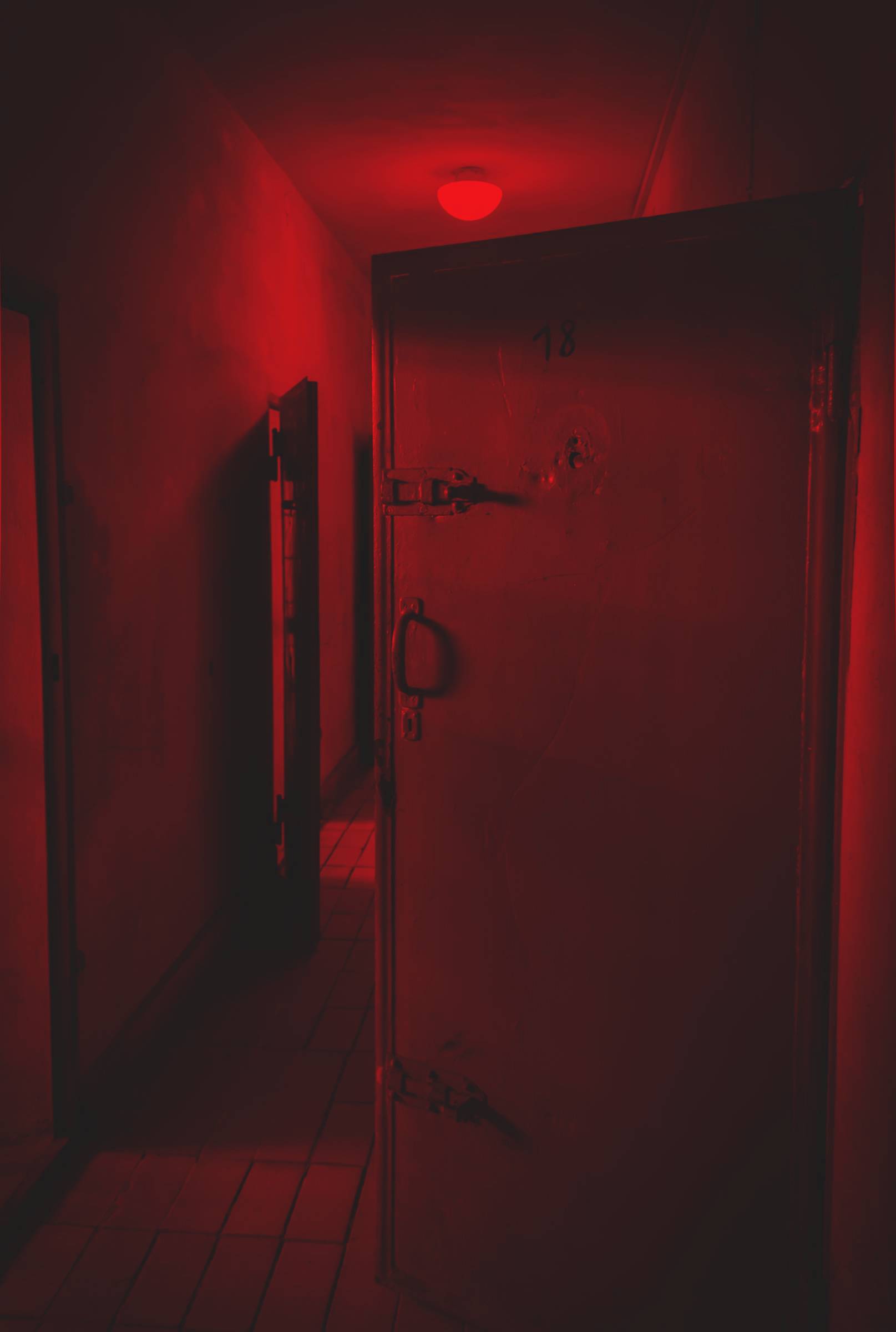
I HAVE not yet met the man in No. 212. I do not even know his name. He never patronizes the hotel restaurant, and he does not use the lobby. On the three occasions when we passed each other by, we did not speak, although we nodded in a semi-cordial, noncommittal way. I should like very much to make his acquaintance. It is lonesome in this dreary place. With the exception of the aged lady down the corridor, the only permanent guests are the man in No. 212 and myself. However, I should not complain, for this utter quiet is precisely what the doctor prescribed.

I wonder if the man in No. 212, too, has come here for a rest. He is so very pale. Yet I can not believe that he is ill, for his paleness is not of a sickly cast, but rather wholesome in its ivory clarity. His carriage is that of a man enjoying the best of health. He is tall and straight. He walks erectly and with a brisk, athletic stride. His pallor is no doubt congenital, else he would quickly tan under this burning, summer sun.

He must have traveled here by auto, for he certainly was not a passenger on the train that brought me, and he checked in only a short time after my arrival. I had briefly rested in my room and was walking down the stairs when I encountered him ascending with his bag. It is odd that our venerable bell-boy did not show him to his room.

It is odd, too, that, with so many vacant rooms in the hotel, he should have chosen No. 212 at the extreme rear. The building is a long, narrow affair three stories high. The rooms are all on the east side, as the west wall is flush with a decrepit business building. The corridor is long and drab, and its stiff, bloated paper exudes a musty, unpleasant odor. The feeble electric bulbs that light it shine dimly as from a tomb. Revolted by this corridor, I insisted vigorously upon being given No. 201, which is at the front and blessed with southern exposure. The room clerk, a disagreeable fellow with a Hitler mustache, was very reluctant to let me have it, as it is ordinarily reserved for his more profitable transient trade. I fear my stubborn insistence has made him an enemy.

If only I had been as self-assertive thirty years ago! I should now be a full-fledged professor instead of a broken-down assistant. I still smart from the cavalier manner in which the president of the university summarily recommended my vacation. No doubt he acted for my best interests. The people who have dominated my poor life invariably have.

Oh, well, the summer’s rest will probably do me considerable good. It is pleasant to be away from the university. There is something positively gratifying about the absence of the graduate student face.

If only it were not so lonely! I must devise a way of meeting the pale man in No. 212. Perhaps the room clerk can arrange matters.

I HAVE been here exactly a week, and if there is a friendly soul in this miserable little town, he has escaped my notice. Although the tradespeople accept my money with flattering eagerness, they studiously avoid even the most casual conversation. I am afraid I can never cultivate their society unless I can arrange to have my ancestors recognized as local residents for the last hundred and fifty years.

Despite the coolness of my reception, I have been frequently venturing abroad. In the back of my mind I have cherished hopes that I might encounter the pale man in No. 211. Incidentally, I wonder why he has moved from No. 212. There is certainly little advantage in coming only one room nearer to the front. I noticed the change yesterday when I saw him coming out of his new room.

We nodded again, and this time I thought I detected a certain malign satisfaction in his somber, black eyes. He must know that I am eager to make his acquaintance, yet his manner forbids overtures. If he wants to make me go all the way, he can go to the devil. I am not the sort to run after anybody. Indeed, the surly diffidence of the room clerk has been enough to prevent me from questioning him about his mysterious guest.

I WONDER where the pale man takes his meals. I have been absenting myself from the hotel restaurant and patronizing the restaurants outside. At each I have ventured inquiries about the man in No. 210. No one at any restaurant remembered his having been there. Perhaps he has entrée into the Brahmin homes of this town. And again, he may have found a boarding-house. I shall have to learn if there be one.

The pale man must be difficult to please, for he has again changed his room. I am baffled by his conduct. If he is so desirous of locating himself more conveniently in the hotel, why does he not move to No. 202, which is the nearest available room to the front?

Perhaps I can make his inability to locate himself permanently an excuse for starting a conversation. “I see we are closer neighbors now,” I might casually say. But that is too banal. I must await a better opportunity.

HE HAS done it again! He is now occupying No. 209. I am intrigued by his little game. I waste hours trying to fathom its point. What possible motive could he have? I should think he would get on the hotel people’s nerves. I wonder what our combination bellhop-chambermaid thinks of having to prepare four rooms for a single guest. If he were not stone-deaf, I would ask him. At present I feel too exhausted to attempt such an enervating conversation.

I am tremendously interested in the pale man’s next move. He must either skip a room or remain where he is, for a permanent guest, a very old lady, occupies No. 208. She has not budged-from her room since I have been here, and I imagine that she does not intend to.

I wonder what the pale man will do. I await his decision with the nervous excitement of a devotee of the track on the eve of a big race. After all, I have so little diversion.

WELL, the mysterious guest was not forced to remain where he was, nor did he have to skip a room. The lady in No. 208 simplified matters by conveniently dying. No one knows the cause of her death, but it is generally attributed to old age. She was buried this morning. I was among the curious few who attended her funeral. When I returned home from the mortuary, I was in time to see the pale man leaving her room. Already he has moved in.

He favored me with a smile whose meaning I have tried in vain to decipher. I can not but believe that he meant it to have some significance. He acted as if there were between us some secret that I failed to appreciate. But, then, perhaps his smile was meaningless after all and only ambiguous by chance, like that of the Mona Lisa.

MY MAN of mystery now resides in No. 207, and I am not the least surprized. I would have been astonished if he had not made his scheduled move, I have almost given up trying to understand his eccentric conduct. I do not know a single thing more about him than I knew the day he arrived. I wonder whence he came. There is something indefinably foreign about his manner. I am curious to hear his voice. I like to imagine that he speaks the exotic tongue of some far-away country. If only I could somehow inveigle him into conversation! I wish that I were possessed of the glib assurance of a college boy, who can address himself to the most distinguished celebrity without batting an eye. It is no wonder that I am only an assistant professor.

I AM worried. This morning I awoke to find myself lying prone upon the floor. I was fully clothed. I must have fallen exhausted there after I returned to my room last night.

I wonder if my condition is more serious than I had suspected. Until now I have been inclined to discount the fears of those who have pulled a long face about me. For the first time I recall the prolonged hand-clasp of the president when he bade me good-bye from the university. Obviously he never expected to see me alive again.

Of course I am not that unwell. Nevertheless, I must be more careful. Thank heaven I have no dependents to worry about. I have not even a wife, for I was never willing to exchange the loneliness of a bachelor for the loneliness of a husband.

I can say in all sincerity that the prospect of death does not frighten me. Speculation about life beyond the grave has always bored me. Whatever it is, or is not, I’ll try to get along.

I have been so preoccupied about the sudden turn of my own affairs that I have neglected to make note of a most extraordinary incident. The pale man has done an astounding thing. He has skipped three rooms and moved all the way to No. 203. We are now very close neighbors. We shall meet oftener, and my chances for making his acquaintance are now greater.

I HAVE confined myself to my bed during the last few days and have had my food brought to me. I even called a local doctor, whom I suspect to be a quack. He looked me over with professional indifference and told me not to leave my room. For some reason he does not want me to climb stairs. For this bit of information he received a ten-dollar bill which, as I directed him, he fished out of my coat pocket. A pickpocket could not have done it better.

He had not been gone long when I was visited by the room clerk. That worthy suggested with a great show of kindly concern that I use the facilities of the local hospital. It was so modern and all that. With more firmness than I have been able to muster in a long time, I gave him to understand that I intended to remain where I am. Frowning sullenly, he stiffly retired. The doctor must have paused long enough downstairs to tell him a pretty story. It is obvious that he is afraid I shall die in his best room.

The pale man is up to his old tricks. Last night, when I tottered down the hall, the door of No. 202 was ajar. Without thinking, I looked inside. The pale man sat in a rocking-chair idly smoking a cigarette. He looked up into my eyes and smiled that peculiar, ambiguous smile that has so deeply puzzled me. I moved on down the corridor, not so much mystified as annoyed. The whole mystery of the man’s conduct is beginning to irk me. It is all so inane, so utterly lacking in motive.

I feel that I shall never meet the pale man. But, at least, I am going to learn his identity. Tomorrow I shall ask for the room clerk and deliberately interrogate him.

I KNOW now. I know the identity of the pale man, and I know the meaning of his smile.

Early this afternoon I summoned the room clerk to my bedside.

“Please tell me,” I asked abruptly, “who is the man in No. 202?”

The clerk stared wearily and uncomprehendingly.

“You must be mistaken. That room is unoccupied.”

“Oh, but it is,” I snapped in irritation. “I myself saw the man there only two nights ago. He is a tall, handsome fellow with dark eyes and hair. He is unusually pale. He checked in the day that I arrived.”

The hotel man regarded me dubiously, as if I were trying to impose upon him.

“But I assure you there is no such person in the house. As for his checking in when you did, you were the only guest we registered that day.”

“What? Why, I’ve seen him twenty times! First he had No. 212 at the end of the corridor. Then he kept moving toward the front. Now he’s next door in No. 202.”

The room clerk threw up his hands.

“You’re crazy!” he exclaimed, and I saw that he meant what he said.

I shut up at once and dismissed him. After he had gone, I heard him rattling the knob of the pale man’s door. There is no doubt that he believes the room to be empty.

Thus it is that I can now understand the events of the past few weeks. I now comprehend the significance of the death in No. 207. I even feel partly responsible for the old lady’s passing. After all, I brought the pale man with me. But it was not I who fixed his path. Why he chose to approach me room after room through the length of this dreary hotel, why his path crossed the threshold of the woman in No. 207, those mysteries I can not explain.

I suppose I should have guessed his identity when he skipped the three rooms the night I fell unconscious upon the floor. In a single night of triumph he advanced until he was almost to my door.

He will be coming by and by to inhabit this room, his ultimate goal. When he comes, I shall at least be able to return his smile of grim recognition.

Meanwhile, I have only to wait beyond my bolted door.

*****

The door swings slowly open….